
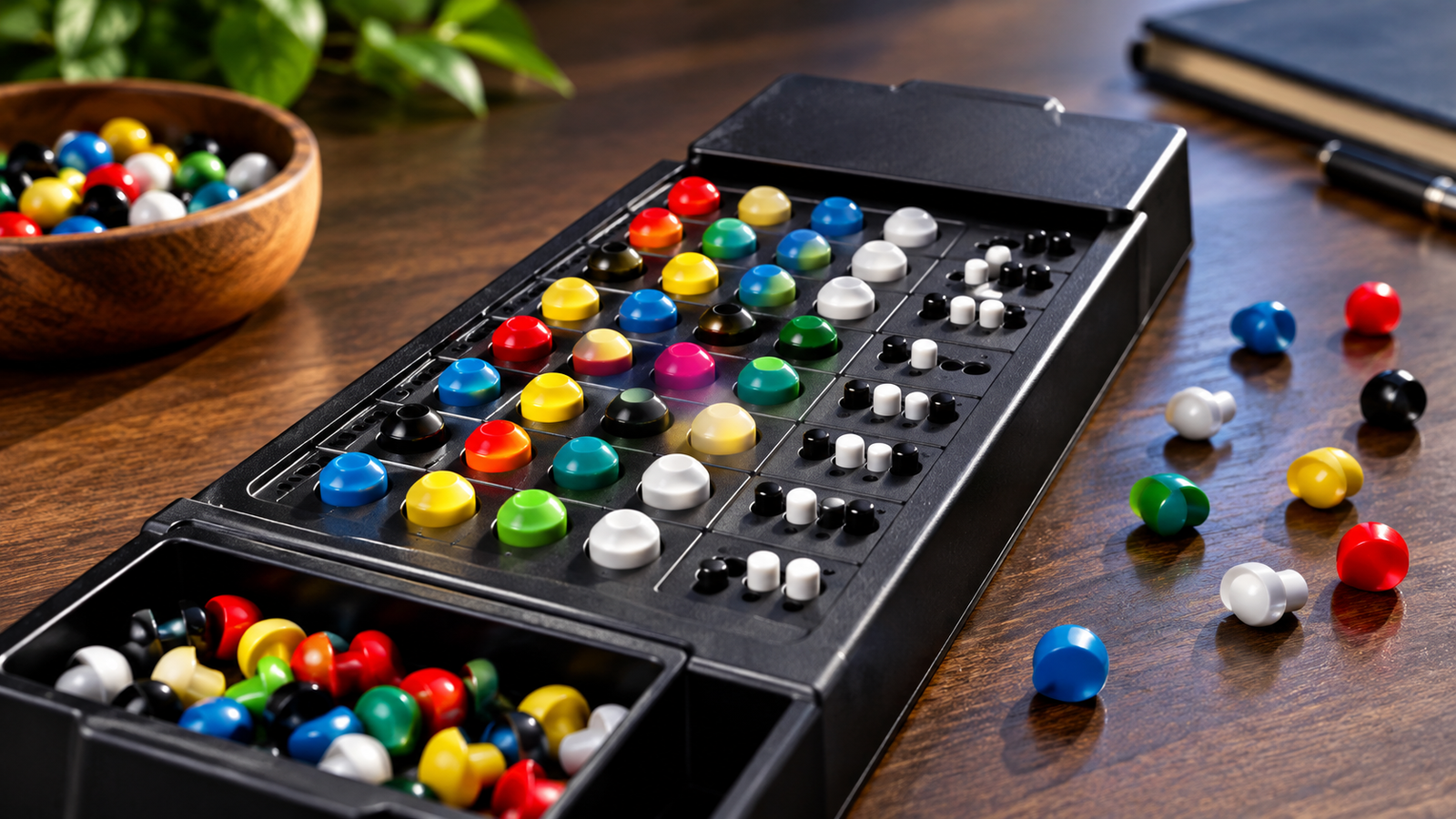
The mastermind game looks simple. Four hidden pegs, a handful of colors, and a few small clues after every guess. Yet the same board a child can learn in five minutes can leave an adult stuck on guess eight, staring at a row of black and white dots.
This guide covers the rules, how to read the clue pegs correctly, a strategy that cuts down the guesses you need, and tips for setting codes that are truly hard to crack. Whether you are opening the box on a family night or playing a free online version, you will finish with a plan.
What Is the Mastermind Game?
Mastermind is a logic and deduction game for two players. One player builds a secret code from colored pegs, and the other tries to work it out using only the feedback given after each guess.
It was invented in 1970 by Mordecai Meirowitz, an Israeli postmaster and telecommunications expert. It reached shops in the early 1970s through Invicta Plastics in England. It is a cousin of an older pencil and paper game called Bulls and Cows, and publisher figures cited on BoardGameGeek claim more than 55 million copies sold.
A round takes 10 to 30 minutes, and most boxes list ages 8 and up. That combination of quick rounds and real depth is why it has stayed on shelves for over fifty years.
What You Need to Play
A standard set has four parts:
- A decoding board with rows of large holes for guesses and small holes for feedback. Most boards have 8 to 12 rows.
- A shield at one end that hides the secret code from the codebreaker.
- Code pegs in six colors, used to build the secret and to make guesses.
- Key pegs in black (sometimes red) and white, used only for feedback.
That is all. No dice, no cards, no luck.
How to Play the Mastermind Game Step by Step
Choose Roles and Agree on Rules
One player is the codemaker and the other is the codebreaker. Before starting, agree on two things: whether a color can appear more than once in the code, and whether empty holes are allowed. Most players allow repeated colors, and that is the version this guide assumes.
Build the Secret Code
The codemaker places four pegs behind the shield where the codebreaker cannot see them. The order matters as much as the colors.
Make a Guess
The codebreaker fills one row with four code pegs. Every guess should be a full row, and it should follow the rules you agreed on.
Give Feedback
The codemaker answers each guess with key pegs. A black peg means one guessed peg is the right color in the right position. A white peg means one guessed peg is a correct color but in the wrong position. No peg means that guessed peg has no match left in the code.
Key pegs are placed in any order. Their position does not point to a specific peg in the guess, which is what makes the game a puzzle.
Finish the Round and Score
The round ends when the codebreaker gets four black pegs or runs out of rows. Then the players swap roles. Traditionally the codemaker scores one point for every guess the codebreaker uses, plus one bonus point if the code is never cracked. Play an even number of rounds so both players get equal turns at each role.
How to Read the Clue Pegs Without Getting Confused
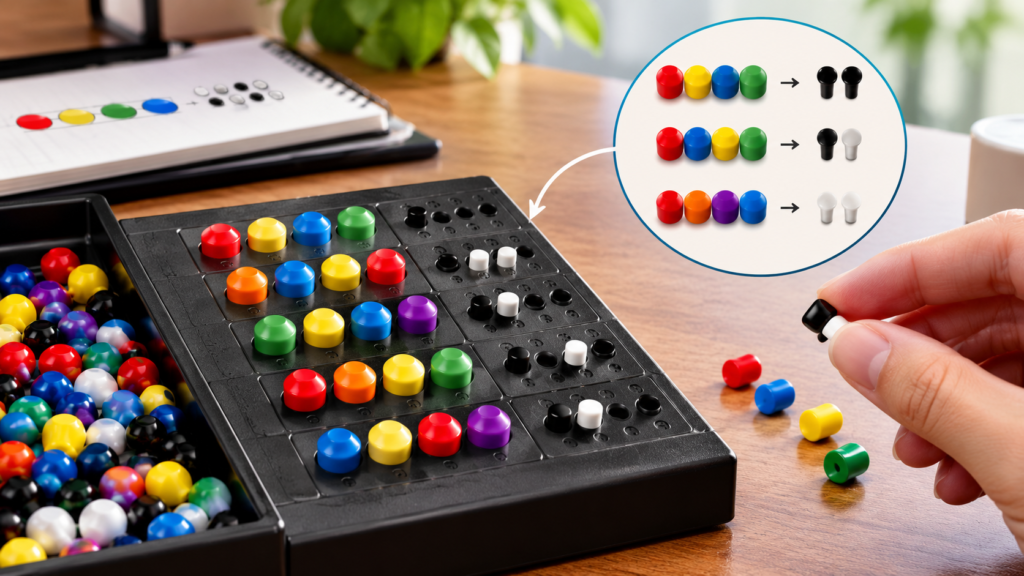
Feedback is a count, not a map. Two black pegs tell you that two guessed pegs are perfect, but not which two. That gap is where all the thinking happens.
The trickiest part is repeated colors. A guess can only earn as many pegs for a color as the secret actually contains.
Here is an example. Say the secret is Red, Blue, Blue, Yellow. You guess Blue, Blue, Blue, Red. Two blues sit in the correct places, so you get two black pegs. The first blue in your guess has no partner left, because the secret only holds two blues and both are already matched. The red is in the secret but in the wrong spot, so it earns one white peg.
The final answer is two black and one white. Many beginners expect an extra peg for that third blue. Remember that each peg in the secret can be matched only once.
A Worked Example, Guess by Guess
The six colors are Red, Blue, Green, Yellow, Orange and Purple. Suppose the secret is Yellow, Blue, Red, Blue. You cannot see it, of course.
- Guess: Red, Red, Blue, Blue. Feedback: one black, two white.
- Guess: Green, Green, Yellow, Yellow. Feedback: no black, one white.
Now read the clues. The first guess used only red and blue, and it earned three pegs in total. So at least three of the secret pegs are red or blue. The second guess used green and yellow, and it earned exactly one peg, which means exactly one secret peg is green or yellow.
That accounts for all four positions, so orange and purple are gone entirely. Two guesses have not solved the code, but they have removed a large part of the search. You now know the color mix, and the rest of the game is about positions.
Mastermind Strategy: How to Win Faster
With four holes and six colors there are 1,296 possible codes when repeats are allowed. In 1976 the computer scientist Donald Knuth showed that a perfect codebreaker can always solve any of them in five guesses or fewer. Later research put the best average at roughly 4.3 guesses.
You will not match a computer, but you can borrow its habits.
Open With a Pair Pattern
Start with two colors in pairs, such as Red, Red, Blue, Blue. This shape reveals how many reds and blues exist while also giving useful position information. Knuth’s method opens the same way.
Learn the Colors Before the Positions
Use your first two or three guesses to find out which colors are in the code and how many times each appears. Trying to place pegs before you know the palette wastes guesses.
Keep a Written Record
Jot down each guess and its feedback, plus what you have ruled out. Memory fails around guess five, and a short note such as “no green” or “one yellow, positions 1 or 2” prevents costly repeats.
Guess to Learn, Not Only to Win
A guess that could be the answer feels exciting, but it is not always the smartest move. Sometimes a guess that cannot possibly be correct splits the remaining possibilities more cleanly. Knuth’s analysis found that this is occasionally necessary to guarantee a win in five.
Test One Idea at a Time
If you change three things between guesses, the feedback becomes hard to interpret. Move one peg or swap one color so the change in feedback points to a clear cause.
How to Be a Tougher Codemaker
Being a good codemaker is half the game, because your points come from long rounds. Most people build codes that feel random but are not. They avoid repeats, or they place colors in the same order as the tray.
Try these habits instead:
- Use repeated colors, including patterns like two pairs or three of one color.
- Choose the code by drawing pegs from a bag, not by deciding.
- Avoid using every color once, since it is the most common human choice.
- Stay honest and careful when giving feedback. One wrong key peg can ruin a round for both players.
In theory, a random code that uses at least two colors is the hardest kind to break. Single color codes are easy to find quickly.
Popular Variations and Difficulty Settings
The original layout has four holes and six colors. Publishers have produced many versions since, so you can adjust the challenge to your group.
| Version | Setup | Best for |
|---|---|---|
| Original Mastermind | 4 holes, 6 colors | Beginners and families |
| Super Mastermind | 5 holes, 8 colors | Experienced players |
| Mini or travel version | Small board, fewer rows | Trips and short breaks |
| Number Mastermind | Digits instead of colors | Players who like math |
| Word Mastermind | Letters, valid words only | Word game fans |
| Electronic handheld | Computer as codemaker | Solo play |
You can also make house rules. Allowing blanks as an extra color makes a game harder. Telling the codebreaker only which colors are right, not their positions, makes it easier for younger children.
Playing the Mastermind Game Online and on Paper
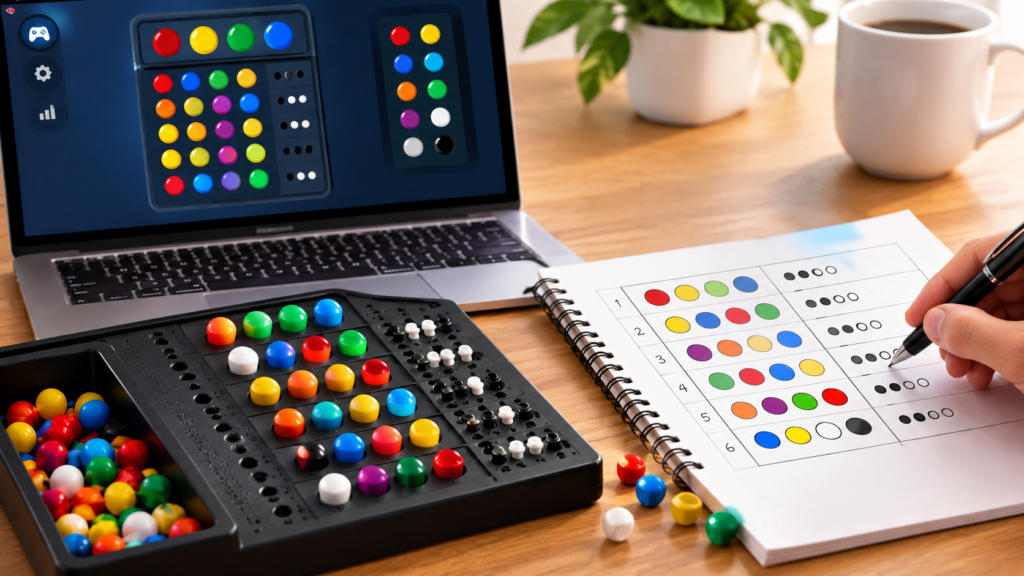
You do not need a physical board. Many websites offer free versions where the computer sets the code, and they are ideal for practicing the strategy above. They usually give around eight to ten attempts.
Paper works just as well. Use digits or letters instead of colors and mark feedback with plus and circle symbols. This is essentially the older Bulls and Cows game, where a bull is the right digit in the right place and a cow is the right digit in the wrong place.
Some people compare Mastermind to Wordle, and the link is real. Both are guessing games driven by feedback. The difference is that Wordle tells you exactly which letter is right or wrong, while Mastermind only gives counts. That makes it harder in some ways and more satisfying to reason through.
Why Families and Classrooms Like It
Mastermind encourages careful thinking. Players hold several possibilities in mind, test them against evidence, and change their minds when a clue contradicts an assumption. It suits children who are ready to reason in steps, and it works for adults who want a quiet, focused game.
It is fair to say it exercises logic and patience, but do not expect it to be a shortcut to a sharper mind. Treat it as a good, low pressure way to practice deduction while having fun.
Common Mistakes to Avoid
- Forgetting that key peg positions do not match guess positions.
- Ignoring duplicates when reading white pegs.
- Wasting early guesses on random colors instead of a pair pattern.
- Not writing anything down.
- Changing too many pegs at once.
- Giving sloppy feedback as the codemaker.
Fixing even two of these will shave a guess or more off your average.
Conclusion
The mastermind game rewards patience more than luck. Learn the feedback rules, especially how repeated colors work, then use your first guesses to find the color mix before hunting for positions. Keep notes, change one thing at a time, and set your own codes at random when you are the codemaker.
Start with the original four hole, six color board, then move to bigger variations once the basics feel easy. Play a few rounds with this approach and you will see your guess count drop.
Frequently Asked Questions
How many guesses do you get in Mastermind?
It depends on the board. Most physical sets have 8 to 12 rows, and many online versions allow around 8 to 10 attempts.
What is the best first guess?
A pair pattern such as Red, Red, Blue, Blue is a strong opener. It gives useful information about both colors and their positions at once.
Can a color appear more than once in the code?
Yes, in most standard rule sets. Players should agree on this before the game starts, because it changes the strategy considerably.
Can you play Mastermind alone?
Yes. Free online versions and electronic handheld sets let the computer act as the codemaker, so you can practice solo.
Is Mastermind the same as Wordle?
No. They share the idea of learning from feedback, but Wordle identifies exactly which letters are right or wrong. Mastermind only gives counts of correct pegs, so you must work out which ones they are.
