
If you have ever sat down to write the methodology chapter of a dissertation and felt completely lost, you are not alone. Most students hit a wall the moment they realize that a strong research methodology is not just about picking a survey or an interview guide. It is about making a series of connected decisions, each one shaping the next.
That is exactly the problem the research onion was designed to solve. Developed by Mark Saunders, Philip Lewis, and Adrian Thornhill, the research onion gives researchers a structured way to think through every choice that goes into a sound research design, starting from broad philosophical assumptions and working inward toward the practical details of collecting and analyzing data.
In this guide, we will walk through every layer of the research onion in plain language, show you how the layers connect to one another, and give you practical examples you can apply to your own project. By the end, you should be able to explain and justify your methodology chapter with real confidence, not just guesswork.
What Is the Research Onion
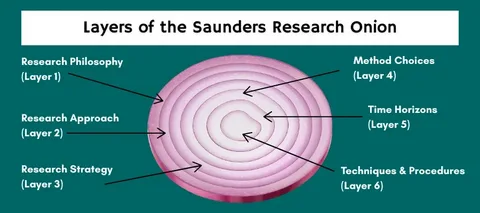
The research onion is a visual framework that maps out the decisions involved in designing a research methodology. Picture six concentric rings, much like the layers of an actual onion. The outer rings represent broad, abstract choices, such as your worldview about knowledge and reality. The inner rings represent specific, practical choices, such as the exact tools you will use to gather and examine your data.
To reach the center of the onion, meaning the point where you actually collect and analyze data, you have to pass through and justify every layer in between. This is what makes the model so useful. It forces you to think about your research holistically instead of jumping straight to a method because it feels familiar or convenient.
The framework first appeared in the widely used textbook Research Methods for Business Students, and it has since spread far beyond business schools into fields like education, health sciences, computer science, and social policy.
Why the Research Onion Matters for Your Dissertation
A dissertation methodology chapter is not simply a description of what you did. Examiners want to see that your choices are justified and that they logically follow from one another. This is where many students lose marks, not because their method was wrong, but because they never explained why it was the right fit for their research question.
The research onion gives you a ready made structure for that justification. Instead of writing a list of unrelated decisions, you can present your methodology as a coherent chain of reasoning, from philosophy through to technique. This also makes peer review and supervisor feedback much easier to act on, since any weak link in the chain becomes obvious.
Layer One: Research Philosophy
The outermost layer of the research onion is research philosophy. This layer deals with your assumptions about the nature of reality, known as ontology, and your assumptions about how knowledge can be acquired, known as epistemology.
There are five commonly recognized research philosophies:
- Positivism: reality is objective and measurable, and research should be conducted like the natural sciences, often relying on quantifiable data and testable hypotheses.
- Interpretivism: reality is socially constructed and subjective, so research focuses on understanding meaning through the eyes of participants.
- Critical realism: there is an objective reality, but our understanding of it is always shaped by social conditioning and interpretation.
- Postmodernism: knowledge is shaped by power, language, and discourse, and there is no single fixed truth to uncover.
- Pragmatism: the research question matters more than any single philosophical stance, so researchers are free to combine approaches based on what will actually answer the question.
Choosing a philosophy is not an academic formality. It shapes everything that follows, including whether you lean toward numbers or narratives, and whether you aim to test theory or build it from the ground up.
Layer Two: Research Approach
The second layer is your research approach, and it concerns the relationship between theory and your research.
There are three main approaches:
- Deductive: you start with an existing theory, form a hypothesis, and then collect data to test it. This approach tends to pair naturally with positivism.
- Inductive: you start by collecting data and use patterns within that data to build new theory or insight. This pairs well with interpretivism.
- Abductive: you move back and forth between data and theory, often starting with an observed surprise or anomaly and working to explain it, refining your framework as you go.
A helpful way to think about this: deductive research tests what we already believe, inductive research builds new understanding from observation, and abductive research does a bit of both at once.
Layer Three: Research Strategy
Your research strategy is the overall plan for answering your research question. Saunders and colleagues describe several strategies, and your choice should reflect both your philosophy and your approach.
Common strategies include:
- Experiment: manipulating one or more variables under controlled conditions to observe cause and effect.
- Survey: collecting standardized data from a large sample, typically through questionnaires.
- Case study: an in depth investigation of one organization, event, or individual within its real world context.
- Ethnography: immersing yourself in a group’s environment to understand their culture and practices from the inside.
- Action research: working collaboratively with participants to solve a practical problem while generating knowledge in the process.
- Grounded theory: building theory directly from systematically collected and analyzed data, without starting from an existing hypothesis.
- Archival research: analyzing existing documents, records, or historical data rather than collecting new data firsthand.
There is no universally superior strategy. A case study might be perfect for exploring a single company’s culture, while a survey would suit a study measuring attitudes across thousands of employees.
Layer Four: Methodological Choices
This layer refers to whether your study uses a single method or a combination of methods.
- Mono method: relying on one data collection technique and one analysis procedure, either purely qualitative or purely quantitative.
- Mixed methods: combining both qualitative and quantitative techniques within the same study, often to cross check findings or capture different dimensions of a problem.
- Multi method: using more than one qualitative technique, or more than one quantitative technique, without necessarily combining the two paradigms.
Choosing mixed methods can add real depth to your project, but it also adds complexity, since you need to justify how the different data types will work together rather than sit side by side unrelated.
Layer Five: Time Horizon
The fifth layer asks a simple but important question: are you capturing a single moment in time, or are you tracking change over a period?
- Cross sectional: data is collected at one point in time, giving you a snapshot of a phenomenon as it currently stands. Most student dissertations, given their tight timelines, use this approach.
- Longitudinal: data is collected repeatedly over an extended period, allowing you to observe development, trends, or change.
If your research question includes words like “over time,” “trend,” or “change,” a longitudinal design is usually the better fit, provided you have the time and resources to sustain it.
Layer Six: Techniques and Procedures
At the very center of the research onion sit the techniques and procedures you will actually use to collect and analyze data. This is the layer most students think about first, but it should really be the layer you finalize last, once everything above it has been decided.
Data collection techniques include interviews, questionnaires, focus groups, observation, and document analysis. Data analysis techniques include statistical testing, regression modeling, thematic analysis, content analysis, and discourse analysis.
At this stage you will also decide on your sampling strategy, whether that is random sampling for quantitative generalization or purposive sampling for qualitative depth, and how you plan to address research ethics such as informed consent and data protection.
How the Layers Connect to Each Other
One detail that often gets lost in simplified explanations is that the layers of the research onion are not independent. Each choice constrains and informs the next.
If you adopt a positivist philosophy, a deductive approach naturally follows, since you are testing existing theory rather than generating it. That, in turn, points you toward a strategy like a survey or an experiment, a mono method quantitative design, a cross sectional time horizon in most student projects, and structured techniques such as closed ended questionnaires analyzed with statistical software.
If instead you lean toward interpretivism, an inductive approach fits better, which might lead you toward a case study or ethnographic strategy, a qualitative mono method design, potentially a longitudinal time horizon if you are tracking change, and techniques such as semi structured interviews analyzed through thematic coding.
Seeing the onion as an interconnected system, rather than six separate boxes to tick, is what separates a strong methodology chapter from a weak one.
A Worked Example: Applying the Research Onion to a Real Study
Imagine a student researching how remote work has affected team collaboration within a mid sized software company. Here is how the layers might unfold as one connected chain of reasoning.
The student believes that employees construct their own meaning of collaboration based on personal experience, so they adopt an interpretivist philosophy. Because they want to build understanding from employee experiences rather than test a fixed hypothesis, they choose an inductive approach.
Given that goal, a case study strategy focused on this single company makes sense. They opt for a mono method qualitative design, relying entirely on semi structured interviews. Since the company shifted to remote work eighteen months ago and the student wants to understand how attitudes have shifted since then, they choose a longitudinal time horizon, interviewing the same ten employees at two points, six months apart.
For technique, they conduct one hour interviews, transcribe them, and use thematic analysis to identify recurring patterns around communication, trust, and productivity. Every decision traces back logically to the one before it, which is exactly what an examiner wants to see.
Common Mistakes Students Make With the Research Onion
Even with a clear framework, certain mistakes show up again and again in dissertation methodology chapters.
- Picking a technique first, such as interviews or a survey, and then trying to retrofit a philosophy and approach to justify it after the fact.
- Treating the layers as a simple checklist rather than a connected argument, which makes the chapter read like disconnected definitions copied from a textbook.
- Choosing mixed methods without a clear reason, simply because it sounds more rigorous, without explaining how the qualitative and quantitative elements will actually complement each other.
- Ignoring the time horizon entirely, forgetting to state clearly whether the study is cross sectional or longitudinal.
- Overcomplicating the philosophy section with dense jargon instead of plainly explaining what the researcher believes about knowledge and why it matters for this particular study.
Avoiding these pitfalls often comes down to writing your methodology chapter as a narrative, not a form to be filled in.
Is the Research Onion Right for Every Field
The research onion was originally built with business and management research in mind, and it remains most naturally suited to social sciences, education, and management studies where questions of philosophy and human behavior are central.
Researchers in fields like computer science, engineering, or the natural sciences sometimes find the outer layers, particularly research philosophy, feel abstract or unnecessary for their work. In these cases, some scholars adapt the model, spending less time on philosophy and more on the practical layers such as strategy and technique.
If you are working in a nontraditional field, it is worth asking your supervisor whether a full six layer treatment is expected, or whether a simplified version focusing on approach, strategy, and technique will serve your project better.
Practical Tips for Writing Your Methodology Chapter
- Start by writing one sentence for each layer stating your choice and the reason behind it, then expand each sentence into a paragraph once the logical chain feels solid.
- Use your research question as the anchor for every decision. If a choice does not clearly serve your research question, reconsider it.
- Read a few examples of completed methodology chapters in your specific field, since expectations vary meaningfully between disciplines.
- Discuss your planned onion with your supervisor before you start collecting data, not after, since a flaw in your philosophy or approach can be far more costly to fix once data collection is underway.
- Keep a short methodology log as you make decisions, noting the date and your reasoning. This becomes incredibly useful when you sit down to write the final chapter.
Conclusion
The research onion turns an overwhelming task, designing a research methodology from scratch, into a manageable sequence of decisions. By working from the outside in, starting with your research philosophy and approach, moving through strategy and methodological choices, and finishing with your time horizon and specific techniques, you build a methodology that holds together logically from start to finish.
The real value of the framework is not the diagram itself, but the discipline it encourages. Every choice you make should trace back to the one before it and forward to your research question. If you can explain that chain clearly, your methodology chapter will not just describe what you did. It will convince your reader that what you did was the right choice all along.
Frequently Asked Questions
What is the research onion in simple terms?
It is a six layer model that guides researchers through the decisions needed to design a research methodology, starting with broad philosophical beliefs and ending with specific data collection and analysis techniques.
Who created the research onion?
The research onion was developed by Mark Saunders, Philip Lewis, and Adrian Thornhill, and it first appeared in their book Research Methods for Business Students.
Can I mix different research philosophies in one study?
Pragmatism specifically allows researchers to move between philosophical stances based on what best answers the research question, though most other philosophies expect a consistent stance throughout the study.
Do I need to use all six layers in my dissertation?
Most social science and business dissertations address all six layers, though the depth of coverage can vary depending on your field and your supervisor’s expectations.
Is the research onion only for business students?
No. While it was designed with business research in mind, it is now widely applied in education, health, social policy, and even some computer science research, sometimes with adjustments to the outer layers.
