
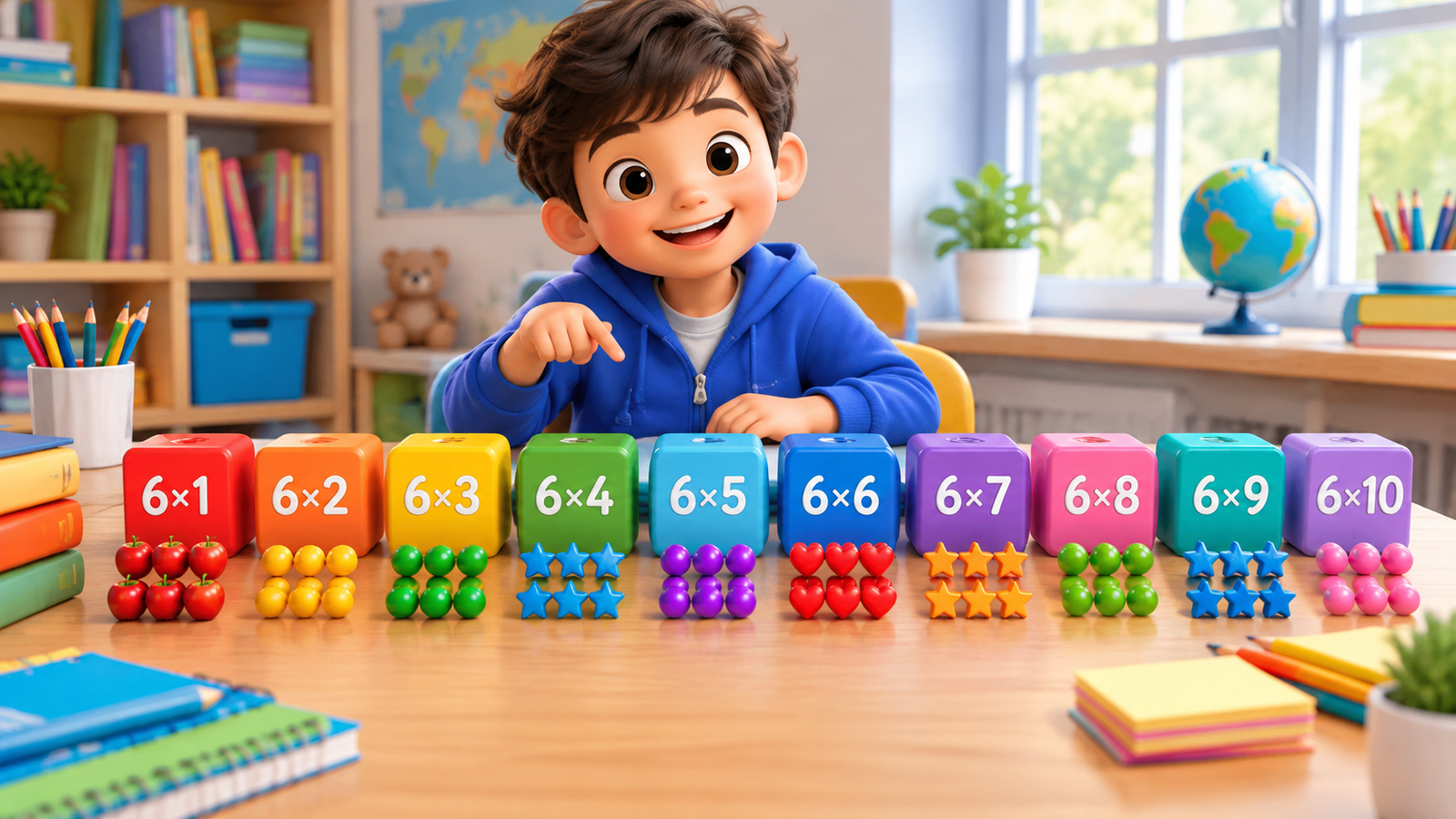
The 6 times table is where many children lose their confidence with multiplication. The 2s, 5s and 10s felt friendly. Then 6 × 7 shows up and nothing seems to stick.
Here is the good news. You do not have to learn twelve separate facts from scratch. Most of the six times table is built from tables your child already knows, and only a handful of facts truly need memorising.
This guide gives you a clear chart, tricks that work (and where they stop working), simple ways to practise, and a five day plan you can start today.
What the 6 Times Table Means
The 6 times table lists the multiples of 6, which are the numbers you land on when you count in sixes. So 6 × 3 means three groups of six, or 6 + 6 + 6, which makes 18.
Multiplication also works in either order. 6 × 3 and 3 × 6 give the same answer, so a child who knows the 3 times table already owns half of the six times table without realising it.
That single idea is the foundation for everything below.
The 6 Times Table Chart Up to 12
Read the chart aloud once, then use the hook column when a fact will not stay in memory.
| Fact | Answer | Memory hook |
|---|---|---|
| 6 × 1 | 6 | Start of the count |
| 6 × 2 | 12 | A dozen |
| 6 × 3 | 18 | Double 9, or double the 3 times table |
| 6 × 4 | 24 | Hours in a day |
| 6 × 5 | 30 | Five sixes, half of 60 |
| 6 × 6 | 36 | A square tray, six rows of six |
| 6 × 7 | 42 | 35 plus 7 |
| 6 × 8 | 48 | 40 plus 8 |
| 6 × 9 | 54 | 60 take away 6 |
| 6 × 10 | 60 | Put a zero after the 6 |
| 6 × 11 | 66 | Repeat the six |
| 6 × 12 | 72 | 60 plus 12 |
Notice that the answers only ever go up by six each time. Counting on from any row gives you the next one.
When Do Children Learn the 6 Times Table?
It depends on the country and the school. In England, children usually meet the six times table in Year 4, when they are aged 8 to 9. By the end of that year they are expected to know every table up to 12 × 12, and they sit the national Multiplication Tables Check in June.
In the United States, students work towards fluency with multiplication facts in grade 3 and often keep consolidating them in grade 4. Other systems sit somewhere in between.
Whatever the label on the year group, the timing is similar. Children come to the six times table after they are comfortable with the 2, 3, 5 and 10 times tables, and that order is deliberate.
Before You Start: Check the Tables It Depends On
Every trick in this guide borrows from an easier table. If those are shaky, the six times table will feel harder than it needs to.
Give your child a quick check: 3 × 7, 5 × 8, 2 × 9 and 10 × 6. If they answer these without long pauses, they are ready. If not, spend a few days there first. It is the fastest route to a steady six times table.
Six Tricks That Make the 6 Times Table Easier
No single trick suits every child. Try two or three and keep the ones that feel natural.
Trick 1: Double the 3 times table
Six is simply three doubled, so every answer in the six times table is double the matching 3 times table answer. To find 6 × 7, think 3 × 7 = 21, then double it to get 42.
This suits children who are confident with threes and comfortable with doubling.
Trick 2: Five plus one more
Six groups are the same as five groups plus one extra group. For 6 × 8, work out 5 × 8 = 40, then add one more 8 to reach 48.
Children who are strong on the 5 times table usually love this method. It also shows why the table makes sense, rather than asking them to trust a pattern.
Trick 3: Ten sixes, take away one
The 10 times table is the easiest of all, so use it as an anchor. For 6 × 9, start at 6 × 10 = 60, then take away one six. That leaves 54.
This is especially handy for 6 × 9, one of the trickier facts.
Trick 4: The even number pattern
When you multiply 6 by an even number, the answer ends in the same digit as that number. Look at 6 × 4 = 24 and 6 × 8 = 48.
For 2, 4, 6 and 8 there is a bonus: the tens digit is exactly half the ones digit, as in 12, 24, 36 and 48. Be careful here. This bonus rule does not extend to 6 × 10 or 6 × 12, so treat it as a shortcut for a few facts and not as a law of the whole table.
Trick 5: The last digit cycle
If you count in sixes, the last digits repeat in a loop: 6, 2, 8, 4, 0. You can hear it in the sequence 6, 12, 18, 24, 30, then 36, 42, 48, 54, 60.
This is a useful error detector. If a child says 6 × 7 = 43, the cycle tells them the answer should end in 2.
Trick 6: The digit sum check
Every number in the six times table is even, and its digits add up to a multiple of 3. Take 54, where 5 + 4 = 9, or 66, where 6 + 6 = 12.
This works as a checking tool, and also as a quick test for larger numbers. For 132, the number is even and 1 + 3 + 2 = 6, so it belongs to the six times table.
The Four Facts That Matter Most
Here is what makes the six times table far less scary than it looks. Children usually know 6 × 1, 6 × 2, 6 × 3, 6 × 4, 6 × 5 and 6 × 10 already. They can get 6 × 11 by repeating the six, and 6 × 12 by adding 60 and 12.
Because order can be swapped, facts such as 7 × 6 or 8 × 6 may also have been learned from the 7 and 8 times tables. That leaves just four facts to focus on.
- 6 × 6 = 36: picture a square tray with six rows of six counters.
- 6 × 7 = 42: an ant has six legs, so seven ants have 42 legs.
- 6 × 8 = 48: the digits are 4 and 8, and 8 is double 4.
- 6 × 9 = 54: the digits add up to 9, just like in the nine times table.
Write these four on a card and keep it somewhere visible, such as the fridge or the inside cover of a school book. A small target feels achievable, and that matters a lot for a nervous learner.
Use Pictures and Real Life Examples
Chanting has its place, but children remember better when they can see what the numbers mean. An array is the simplest picture: six rows of counters with six in each row shows 6 × 6 clearly.
Skip counting adds another layer. Colour the multiples of 6 on a hundred square and you will see them zigzag across the columns in a repeating pattern, which matches the last digit cycle. Children often find this more convincing than hearing about it.
Real objects make the facts stick even further. Try a few of these:
- Egg cartons hold six, so seven cartons hold 42 eggs.
- A six pack of drinks means five packs hold 30 cans.
- Insects have six legs, so eight beetles have 48 legs.
- A hexagon has six sides, so nine separate hexagon tiles have 54 sides in total.
Once children get the idea, ask them to invent their own six times table problems. Writing a puzzle for someone else is a surprisingly strong way to learn.
Games, a Five Day Plan and Practice Questions
Short and regular practice tends to work better than one long session, because the brain benefits from coming back to a fact after a small gap. Ten focused minutes a day is plenty.
Games that build recall
- Roll and say: Roll a dice, multiply the number by 6 and say the answer. One point for every correct answer.
- Three piles: Sort flash cards into “instant”, “after thinking” and “still learning”. Only practise the third pile.
- Fizz with six: Count up together, but replace every multiple of 6 with a silly word.
- Beat your own time: Give a short sheet of 12 questions, record the time, and try to beat it next time. Compare with yourself and never with siblings.
A five day plan
- Day 1: Read the chart aloud, then skip count in sixes up to 72.
- Day 2: Practise the easy facts using the 5 plus one method and the 3 times table doubled.
- Day 3: Focus on the four facts using the memory hooks above.
- Day 4: Practise in random order, with missing number sequences and a few word problems.
- Day 5: Do a relaxed timed check, then try some division questions.
Return to the four key facts two or three days later. That short gap is what turns a fact into a long term memory.
Practice questions
- 6 × 4
- 9 × 6
- 6 × __ = 42
- What number comes after 48 when counting in sixes?
- Five boxes each hold 6 pencils. How many pencils are there?
- 6 × __ = 60
- Is 78 in the six times table?
Answers: 24, 54, 7, 54, 30, 10. For the last one, 78 is even and 7 + 8 = 15, which is a multiple of 3, so yes, it is 6 × 13.
Common Mistakes and How to Fix Them
Most errors follow predictable patterns. Spotting them early saves a lot of frustration.
Mixing up 6 × 7 and 6 × 8. Children sometimes say 56 for 6 × 8 because 7 × 8 = 56 sits nearby in memory. Use the five plus one method to rebuild the answer, and the last digit cycle to check it.
Adding instead of multiplying. A child who says 12 for 6 × 6 is adding 6 + 6. Go back to arrays and ask how many rows there are.
Only knowing the chant. Some children can recite the table from the start but freeze when asked for 6 × 8 out of order. Practise starting from the middle and jumping around.
Guessing without checking. Teach the digit sum and last digit ideas as a habit. A quick check builds independence and accuracy.
Connect the 6 Times Table to Division
Multiplication facts are more powerful when they work in both directions. If a child knows 6 × 7 = 42, they also know 42 ÷ 6 = 7 and 42 ÷ 7 = 6.
Try asking, “How many sixes are in 54?” It is the same fact from a different angle, and it prepares children for fractions and problem solving later on. Practising fact families together saves time because one memory does the work of several.
Helping a Child Who Feels Stuck
If a child is struggling, keep the atmosphere calm and short. Remove the timer for a while and work on one hard fact per session. Counters, egg boxes or drawing arrays can take pressure off memory.
Praise the strategy as much as the answer. Saying “I like how you used five sixes and added one more” builds a child’s belief that they can work things out. If number facts remain very difficult across several tables despite regular practice, it is worth talking to the class teacher about extra support.
FAQs About the 6 Times Table
What are the multiples of 6 up to 72?
They are 6, 12, 18, 24, 30, 36, 42, 48, 54, 60, 66 and 72.
What is the easiest way to learn the 6 times table?
Start from tables your child already knows. Double the 3 times table, or take the 5 times table and add one more group. Then spend extra time on 6 × 6, 6 × 7, 6 × 8 and 6 × 9.
What age do children learn the 6 times table?
Most children meet it between the ages of 7 and 9. In England, this is usually Year 4, while in the United States it often falls in grade 3 or 4.
How long does it take to learn?
It varies from child to child. With about ten minutes of regular practice, many children feel comfortable within two to three weeks, though speed and recall may take longer.
How can I tell if a number is in the 6 times table?
Check that it is even and that its digits add up to a multiple of 3. For example, 96 is even and 9 + 6 = 15, so it is 6 × 16.
Conclusion
The 6 times table looks like a big step, but it is really a small extension of what children already know. Use the chart to see the pattern, borrow strength from the 3, 5 and 10 times tables, and give special attention to the four facts that matter most.
Keep practice short, mix in games and real examples, and check answers with the last digit cycle and digit sum. A few relaxed minutes each day will do far more than a stressful marathon.
Above all, remember that every child learns at a different pace. With steady support, the six times table can shift from the table everyone dreads to one your child is proud to know.
