

Last winter I walked into my bathroom on a Saturday morning, looked up while the shower warmed, and saw it. A scatter of small black spots had spread across the white ceiling above the shower, with a gray smudge near the corner that had not been there a month earlier. My first thought was to grab the bleach. My second thought was to find out whether bleach would actually fix it. It turns out the answer is no, and the real fix is simpler, cheaper, and safer than I expected. This guide shows how to get rid of mold on bathroom ceiling without bleach, using soap and water, white vinegar, and a few habits that keep the ceiling dry so the spots do not come back.
Why Mold Loves Your Bathroom Ceiling
Mold needs three things to grow: moisture, warmth, and something to feed on. A bathroom hands it all three every single day. Hot showers fill the room with steam. That warm, wet air rises and meets the ceiling, which is usually the coolest surface in the room. The steam condenses into a thin film of water that sits there long after the shower ends. Paint, drywall, and dust give mold plenty to eat.
The pattern is easy to spot once you know it. Spots show up first above the shower or bath, where steam is thickest. They gather in corners, where air barely moves. They creep along the edge where the ceiling meets the wall. In a bathroom with no window, or with a fan that gets switched off the moment the shower ends, the ceiling may stay damp for hours. That is all the invitation mold needs.
Cold weather makes it worse. In winter, windows stay shut, showers get longer and hotter, and the ceiling stays cooler because the room above or the attic is cold. The gap between warm wet air and a cold ceiling is exactly where condensation forms. If you only notice the spots in the colder months, the season is probably part of the story.
Why Bleach Is Not the Fix
Bleach feels like the obvious answer. It is strong, it is cheap, and it turns black spots white in seconds. The problem is that turning a spot white is not the same as removing mold. The United States Environmental Protection Agency says plainly that using a biocide such as chlorine bleach is not recommended as a routine practice during mold cleanup, and that killing mold is not enough. It must also be removed.
Here is why that matters. Bleach works on hard, nonporous surfaces such as tile and glass. A painted ceiling is different. Drywall and paint soak up water, and mold roots reach into that soft surface. Bleach sits on top, lightens the color, and leaves the growth underneath alive. Within weeks, the spots return in the same place, often darker than before.
Bleach also brings risks that the job does not need. The fumes sting eyes and airways, which is the last thing you want while scrubbing overhead with your face tilted up. Mixed with ammonia or with other cleaners, bleach can create toxic gas. And on a painted ceiling, bleach can stain, strip color, and damage the finish you are trying to save. Soap and water do the actual work here. Vinegar handles the rest.
How to Get Rid of Mold on Bathroom Ceiling Without Bleach in 7 Steps
Set aside about an hour. Work in daylight if you can, so you can see every spot. Keep the bathroom door closed while you clean so spores do not drift into the rest of the house, and open a window if the room has one.
Step 1: Check the Size and the Surface First
Before you touch anything, size up the job. The Environmental Protection Agency says you can usually clean a moldy patch yourself if it covers less than about 10 square feet, roughly a 3 foot by 3 foot area. Most bathroom ceiling spots fall well inside that limit.
Press the area gently with a fingertip. If the ceiling feels firm and dry under the spots, you are dealing with surface growth and the steps below will handle it. Stop and call a professional if the ceiling feels soft, spongy, or wet, if it sags, if paint is bubbling and peeling in sheets, or if the patch is larger than 10 square feet. Those signs point to water inside the ceiling, not just on it, and cleaning the surface will not reach the real problem.
Step 2: Gear Up and Protect the Room
Mold cleanup is a job for basic protective gear, not a hazmat suit. Put on rubber gloves, safety goggles, and an N95 respirator mask. Wear old clothes you do not mind throwing away. Cover the floor, the tub, and the sink with plastic sheeting or old towels, because dirty water will drip. Keep children and pets out of the room until you finish and the ceiling is dry.
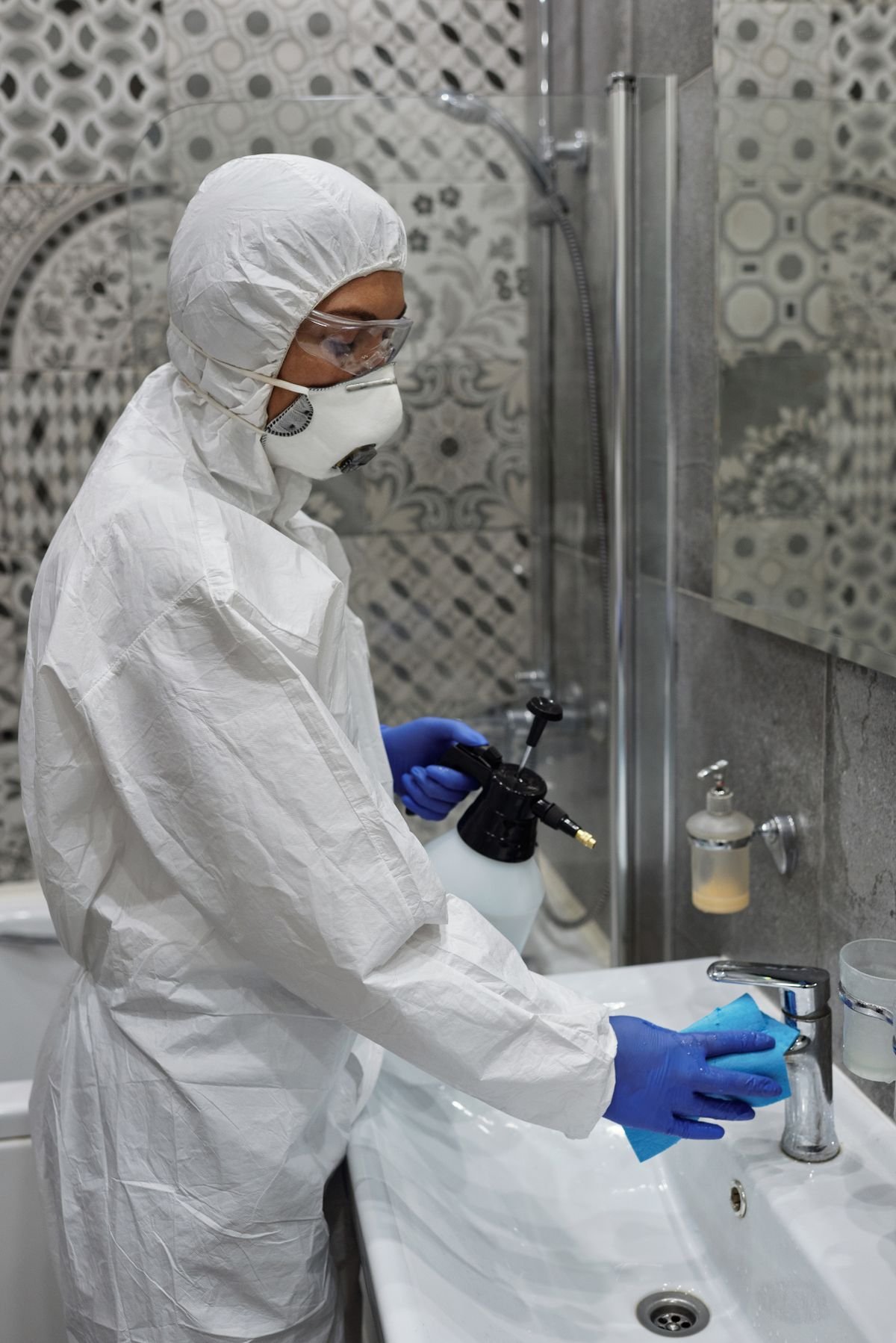
Do not dry scrape, sand, or brush the spots while they are dry. That sends a cloud of spores into the air you are breathing. Every cleaning step below works on a damp surface, which keeps spores out of the air.
Step 3: Scrub With Detergent and Water
This is the step that does the most work, and it is also the simplest. Fill a bucket with warm water and add a few drops of mild dish soap. Dip a sponge or a soft brush into the solution, wring it out well, and scrub the moldy area. Work from the outside edge of each patch toward the center, so you do not smear growth onto clean paint. Rinse the sponge often in a second bucket of clean water, and swap cloths as soon as they pick up discoloration. A dirty cloth spreads mold around instead of removing it.
Use a stable step stool or a small ladder to reach the ceiling safely, and work in sections you can see clearly. A flashlight held at an angle helps you spot faint patches that overhead light hides. Take your time. Gentle, repeated passes beat hard scrubbing, which can damage paint and push moisture deeper into drywall.

Step 4: Treat With White Vinegar
After the visible mold is gone, treat the area with undiluted white vinegar. Pour it into a spray bottle, mist the cleaned area lightly, and let it sit for about 60 minutes. Vinegar is mildly acidic, and it kills many common mold types while it dries. Wipe the area once more with a clean, damp cloth when the hour is up.
For stubborn spots that survive soap and vinegar, 3 percent hydrogen peroxide is a good second option. Spray it on, let it sit for 10 to 15 minutes, then wipe and rinse. Use one treatment at a time. Never mix vinegar, hydrogen peroxide, bleach, or any other cleaner together in the same bottle or on the same surface, because mixed cleaners can create fumes that are dangerous to breathe.
Step 5: Rinse and Dry the Ceiling Completely
Wipe the whole area with a clean cloth dampened with plain water to remove any soap or vinegar residue. Then dry it. This step matters as much as the scrubbing, because mold returns fastest to a surface that stays damp. Point a small fan at the ceiling, leave the exhaust fan running, and open a window if you have one. The Environmental Protection Agency advises drying water damaged areas within 24 to 48 hours to prevent new growth, and a small cleaned patch should be fully dry well inside that window.
Step 6: Check Again in a Week
Come back in seven days and look closely. Shine a flashlight across the ceiling from the side. If the spots are gone and the paint looks clean, the job is done. If faint marks remain, repeat steps 3 through 5 once more. A second pass usually finishes what the first pass loosened.
If the spots return in the same place within days, the moisture source is still active. That is not a cleaning failure. It is a clue. Jump to the prevention section below and find the leak, the fan problem, or the condensation habit that keeps feeding the spot.
Step 7: Repaint Only After the Ceiling Is Fully Dry
Painting over mold is the most common shortcut, and it does not work. Paint seals moisture and growth under a fresh coat, and the spots bleed through again within weeks. Repaint only after the ceiling is clean, fully dry, and the moisture problem is fixed. Use a stain blocking primer first, then two thin coats of ceiling paint. A mold resistant paint adds a little extra protection on a clean, dry ceiling, but no paint can stand in for dry air and a working fan.
How to Tell If the Problem Is Bigger Than a Surface Clean
Most ceiling mold is a surface job. A few signs mean the problem runs deeper, and cleaning alone will not fix it.
- The patch is larger than about 10 square feet, or it keeps growing across the ceiling.
- The ceiling feels soft, spongy, sagging, or wet to the touch.
- Paint bubbles, peels in sheets, or the drywall crumbles.
- A musty smell hangs in the room even when you cannot see any mold.
- Water stains spread in rings, or brown marks appear alongside the black spots.
- The same spot returns within days of a full clean, even with the fan running.
- Someone in the home develops coughing, sneezing, itchy eyes, or wheezing that eases when they leave the house.
Any one of these is a reason to stop and get help. A plumber can find a slow leak from a pipe or a shower pan above. A roofer can check for water coming in from above. A mold remediation company can test the air, open up a small section of ceiling, and clean what you cannot reach. If you rent, tell your landlord in writing and send photos. A leak or a ventilation failure is the property owner’s repair, and a written record protects you if the problem drags on.
How to Stop Mold Coming Back
Cleaning removes mold. Drying stops it returning. Every habit in this section attacks the moisture that feeds ceiling mold, and together they are more powerful than any cleaner.
Run the exhaust fan during every shower and leave it running for 20 to 30 minutes after. This one habit does more than anything else, because it pulls warm wet air out of the room before it can settle on the ceiling. If your fan is old, noisy, or weak, clean its grille and check that the duct vents outside through a roof or wall cap, not into the attic. A fan that dumps wet air into the attic just moves the mold problem upstairs. A timer switch or a humidity sensing fan takes the remembering out of it.
Open a window when the weather allows, even a crack, while you shower. Fresh air drops humidity fast. Leave the shower door or curtain open after use so the wettest corner of the room can dry. Squeegee the shower walls and wipe the tiles after the last shower of the day. It takes a minute, and it removes the water film that mold lives on.
Fix leaks the week you find them, not the month after. A dripping showerhead, a loose tile, a cracked bead of caulk, or a slow drain all keep the room damp around the clock. Recaulk the tub and shower edges when the old caulk pulls away, and reseal grout lines once a year in a heavily used shower.
Keep indoor humidity between 30 and 60 percent. A small hygrometer costs a few dollars and tells you where you stand. If the bathroom stays above 60 percent even with the fan running, a small dehumidifier in or near the bathroom can help, especially in a basement bathroom or a home in a humid climate. Do not dry laundry in the bathroom, and hang wet towels where air can reach them instead of leaving them in a damp pile.
Damp bathrooms attract more than mold. The same wet corners that grow ceiling spots also invite pests that love moisture. If you spot tiny flies near the sink or shower, our guide to drain flies in the bathroom shows how to find the drain they breed in. If you see small silver insects near the skirting, read our guide to silverfish in the bathroom. And if the shower glass is cloudy with mineral film, our guide to soap scum on shower glass uses the same bleach free approach.
When to Call a Professional
Call a professional when the patch is large, the ceiling is damaged, or the moisture source hides inside the structure. A remediation company can handle areas above 10 square feet, growth inside wall cavities, and ceilings that need partial removal. Expect a straightforward job to take a day and cost far less than the repair bill for a ceiling left to rot.
Call a doctor if anyone in the home has breathing trouble, a rash, or allergy symptoms that started with the mold and do not ease after the room is clean and dry. People with asthma, allergies, a weak immune system, or a lung condition should stay out of the room during cleanup entirely, and they should not be the ones doing the scrubbing.
When in doubt, get an opinion before you start. A quick inspection is cheap. A ceiling replaced too late is not.
Conclusion
Black spots on a bathroom ceiling look alarming, but most of them are a small, fixable problem with a simple cause. Steam rises, the ceiling stays cool, water sits, and mold grows. Bleach hides the color without removing the growth, so the spots always return. Soap and water remove the mold, white vinegar treats what remains, and thorough drying finishes the job. The habits that keep it gone are just as simple: run the fan for 20 to 30 minutes after every shower, fix leaks fast, keep humidity between 30 and 60 percent, and let the room dry out every day.
That is the whole story. Clean it once, properly, without bleach. Dry it fully. Then change the air in the room so the ceiling stops staying wet. Do those three things, and you will know how to get rid of mold on bathroom ceiling without bleach for good, instead of scrubbing the same spots again next month.
Frequently Asked Questions
Can I paint over mold on my bathroom ceiling?
No. Paint seals moisture and growth under a fresh coat, and the spots bleed through again within weeks. Clean the mold off first, let the ceiling dry fully, fix the moisture problem, then use a stain blocking primer followed by ceiling paint.
Does vinegar kill mold on ceilings?
Undiluted white vinegar kills many common mold types and helps remove them from painted surfaces. Spray it on after scrubbing with soap and water, let it sit for about 60 minutes, then wipe. Vinegar is a cleaner, not a cure. If the ceiling stays damp, mold will return no matter what you spray on it.
How long does it take for mold to come back after cleaning?
If you fix the moisture, it may never return. If the fan stays off, the window stays shut, and the ceiling stays damp, spots can return within a few weeks. The cleaning lasts as long as the drying habits do.
Is bathroom ceiling mold dangerous?
Small patches are a low risk for most healthy adults when cleaned safely with gloves, goggles, and an N95 mask. Mold can irritate eyes, skin, and airways, and people with asthma, allergies, or a weak immune system are more sensitive. See a doctor if symptoms persist after the room is clean and dry.
Why does mold keep growing in the same spot?
Because the moisture source is still there. A fan that vents into the attic, a slow leak from above, a cold patch of ceiling where steam condenses, or a shower that never fully dries will feed the same spot again and again. Find the water first, then clean. The spot will not return once the ceiling stays dry.
