
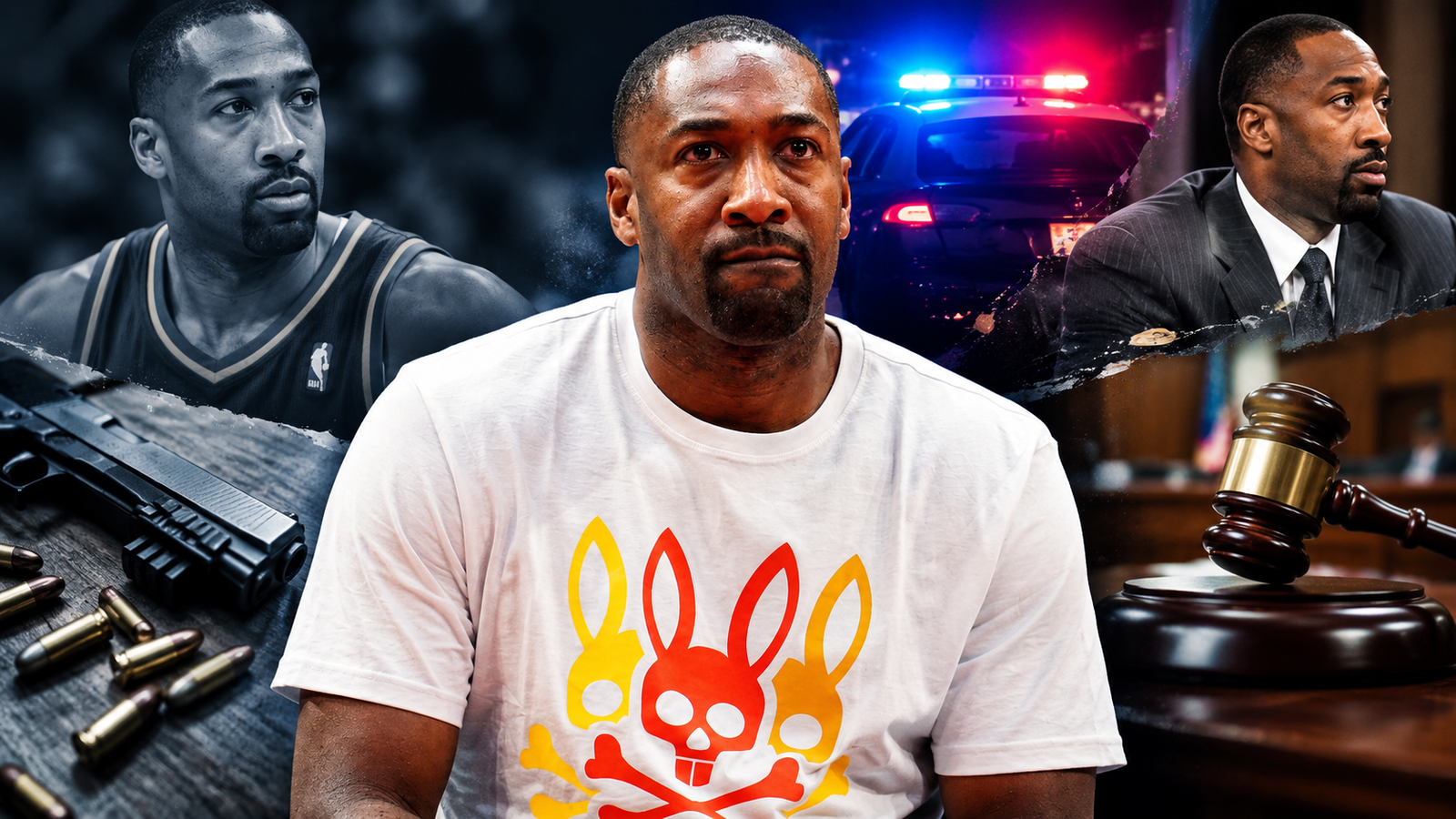
If you search “gilbert arenas gun,” you will find plenty of articles that repeat the same handful of facts: two teammates, a card game, and a locker room standoff that nearly turned violent. What most of those pieces skip is the full arc of the story. They rarely explain how the dispute escalated, what actually happened to both players afterward, or how one man’s career simply stalled while the other’s life spiraled into something far more tragic.
This article walks through the entire Gilbert Arenas gun scandal from start to finish. You will get the timeline, the legal consequences, the public fallout, and an honest look at where both players are today.
What Actually Happened in the Gilbert Arenas Gun Incident
By December 2009, Gilbert Arenas was one of the most recognizable names in the NBA. Nicknamed “Agent Zero,” he had built a reputation as a fearless scorer, a three time All Star, and one of the most colorful personalities the league had seen in years. He also had a six year, $111 million contract with the Washington Wizards, making him one of the richest players in the sport at the time.
His teammate, Javaris Crittenton, was a young guard the Wizards had picked up in a trade. He was talented, quiet off the court, and, according to later accounts, dealing with pressures that few outside the locker room understood.
The two men were friendly enough to play cards together on team flights, and that friendliness is exactly where the trouble started.
The Card Game Dispute That Started It All
On December 19, 2009, following a loss to the Phoenix Suns, Arenas and Crittenton got into an argument over money owed from a card game on the team plane. Accounts differ slightly on the exact amount, but most reporting points to a dispute worth roughly $1,100. Words got heated, teammate Antawn Jamison had to physically separate them, and the tension did not fade once the plane landed.
December 21, 2009: Guns in the Wizards Locker Room
Two days later, before a practice at what was then the Verizon Center, Arenas showed up with four guns and displayed them at his locker stall, the same stalls once used by Michael Jordan. According to Caron Butler’s memoir, “Tuff Juice,” Arenas pointed at the weapons and told Crittenton to pick one, joking that he was going to shoot him.
Crittenton did not treat it as a joke. He pulled out his own loaded, cocked handgun and pointed it at Arenas. Butler, who stayed in the room while other players fled, later said he talked Crittenton down by warning him that pulling the trigger would ruin his life. Crittenton lowered the weapon, and Arenas quietly left the room.
Arenas has disputed parts of Butler’s retelling, particularly the claim that guns were pointed directly at each other in that exact manner, but he has never denied that both men brought firearms into the locker room. That basic fact was confirmed by the NBA, by prosecutors, and by both players’ own guilty pleas.
This Was Not Arenas’ Only Gun Incident
One detail that rarely makes it into mainstream coverage is that the Crittenton confrontation was not the first time Arenas brought a gun into an NBA locker room. In 2022, Arenas revealed that during his rookie season with the Golden State Warriors in 2000, he was involved in a separate incident tied to rookie hazing rituals.
Arenas did not go into the same level of detail about that earlier episode, and no legal action followed it. Still, it adds important context. By the time the Crittenton situation happened, Arenas already had a personal history of treating firearms as something to joke around with in a professional locker room, not as the serious legal and safety issue they actually are.
The Legal and NBA Fallout
Once the story became public in late December 2009, the consequences arrived quickly and from multiple directions at once: the league office, the courts, and eventually the court of public opinion.
Arenas’ Suspension and Guilty Plea
On January 6, 2010, NBA Commissioner David Stern suspended Arenas indefinitely without pay, stating plainly that he was not fit to take the court. Arenas was later charged with felony gun possession by the U.S. Attorney’s Office in Washington, D.C. He pleaded guilty on January 15, 2010, and was ultimately sentenced to 30 days in a halfway house along with probation and community service.
The financial hit was massive. Arenas lost the remainder of his season, which cost him close to $10 million in salary, along with significant damage to his endorsement value.
Crittenton’s Suspension and Guilty Plea
Crittenton also pleaded guilty to a misdemeanor gun charge and was suspended for the rest of the 2009 to 2010 season. Unlike Arenas, Crittenton never played another game in the NBA. He briefly signed with the Charlotte Bobcats in 2010 before being waived, then played overseas in China and in the NBA’s developmental league before his professional basketball career quietly ended.
Arenas’ Public Response Made Things Worse
If the locker room incident itself was the spark, Arenas’ reaction to the fallout poured gasoline on it. Rather than treating the situation with the seriousness the league expected, he joked about it on social media and, before a game in Philadelphia, mimicked firing finger guns at his own teammates during warmups while laughing.
Photos of that moment spread quickly, and Stern has since said it was the final straw that pushed him toward an immediate, indefinite suspension rather than waiting for the legal process to play out. Arenas later admitted the joke was a serious misjudgment of how the public and the league would perceive it, especially given how recently the actual incident had occurred.
Where Gilbert Arenas Ended Up After the Scandal
Arenas’ basketball career never fully recovered its former trajectory, though it did not end abruptly either. The Wizards traded him to the Orlando Magic partway through the following season, and he later played for the Memphis Grizzlies before retiring from the NBA in 2012.
Since retirement, Arenas has stayed connected to basketball culture through commentary, podcasting, and various media appearances, often speaking candidly, sometimes controversially, about his career and the 2009 incident. He has occasionally downplayed how serious the situation was, at one point remarking that he had seen worse behavior in NBA locker rooms, a comment that drew renewed criticism given the gravity of what actually happened.
Financially and reputationally, the scandal remains the defining moment most casual fans associate with his name, overshadowing a career that once included multiple All Star selections and a scoring title race with some of the league’s biggest names.
Where Javaris Crittenton Ended Up: A Far Darker Path
This is the part of the story that most articles about the Gilbert Arenas gun incident leave out entirely, and it is arguably the most important context for understanding how differently these two lives unfolded.
In August 2011, Crittenton was charged with murder in connection with the drive by shooting death of Julian Jones, a 22 year old mother of four in Atlanta. Prosecutors alleged that Crittenton was attempting to shoot a man who had robbed him days earlier, and that Jones was killed instead as an unintended victim.
Crittenton was also arrested on drug trafficking charges in January 2014 while out on bond awaiting trial. In April 2015, as jury selection for his murder trial concluded, he pleaded guilty to voluntary manslaughter and aggravated assault with a deadly weapon, admitting in court that he had been a gang member. He was sentenced to 23 years in prison with additional years of probation.
In 2023, after serving roughly a decade behind bars, Crittenton’s sentence was modified, and he was released from prison on probation. The man once known primarily for a locker room standoff had, by that point, become far better known for a killing that ended an innocent woman’s life and left four children without their mother.
Placed side by side, the two men’s paths after that December 2009 confrontation could not have diverged more sharply. One rebuilt a public career in media. The other spent years in prison for an unrelated, far more serious act of violence.
How the Incident Changed the NBA
The Arenas and Crittenton case became a turning point in how seriously the league treated firearms around its players and facilities. It prompted renewed conversations about the NBA’s personal conduct policy, arena security protocols, and how teams handle disputes between players before they escalate.
While the NBA had already prohibited firearms in team facilities before 2009, the scandal made clear that the rule needed stronger, faster enforcement and clearer communication to players about the real world legal exposure involved, not just the league fine or suspension. Stern’s swift, indefinite suspension of Arenas, issued before legal proceedings even concluded, set a precedent for how quickly the league would act in future off court incidents involving weapons.
Lessons From the Gilbert Arenas Gun Scandal
Looking back more than a decade later, a few practical takeaways stand out.
- A dispute over a relatively small amount of money, roughly $1,100, escalated into a felony charge, a lost season, and millions in forfeited salary.
- Public reaction to a crisis can matter almost as much as the incident itself. Arenas’ jokes and finger gun photo arguably accelerated his suspension.
- One incident does not always predict the future. Arenas’ career, while damaged, continued for several more years and he remained in the public eye afterward.
- For Crittenton, the 2009 incident turned out to be an early warning sign of far more serious problems that the public would not fully understand until 2011.
Frequently Asked Questions
What year did the Gilbert Arenas gun incident happen?
The confrontation took place in December 2009, with the initial dispute occurring on December 19 and the locker room standoff on December 21, at what was then called the Verizon Center in Washington, D.C.
Did Gilbert Arenas go to jail?
Arenas pleaded guilty to a felony gun possession charge and was sentenced to 30 days in a halfway house, along with probation and community service, rather than traditional jail time.
What happened to Javaris Crittenton after the incident?
Crittenton never played in the NBA again. In 2015, he pleaded guilty to voluntary manslaughter in connection with the 2011 shooting death of Julian Jones in Atlanta and was sentenced to 23 years in prison. He was released on probation in 2023.
Did Gilbert Arenas apologize for the incident?
Arenas has spoken about the incident multiple times over the years, at times expressing regret over his public reaction, including the finger gun photo, while also disputing certain details of how the confrontation itself has been retold.
How much money did Gilbert Arenas lose from the suspension?
His season long suspension cost him close to $10 million in salary, in addition to lasting damage to his endorsement opportunities.
Final Thoughts
The Gilbert Arenas gun incident is often remembered as a strange, almost absurd footnote in NBA history: two teammates, a card game debt, and guns in a locker room. But the full story is far heavier than that summary suggests. It reshaped how the league handles off court weapons incidents, ended one player’s NBA career outright, and, years later, intersected with a tragedy that had nothing to do with basketball at all.
Understanding the complete timeline, from the plane argument to the locker room standoff to the very different paths both men walked afterward, gives a much clearer picture of why this story has stayed relevant for well over a decade.
