
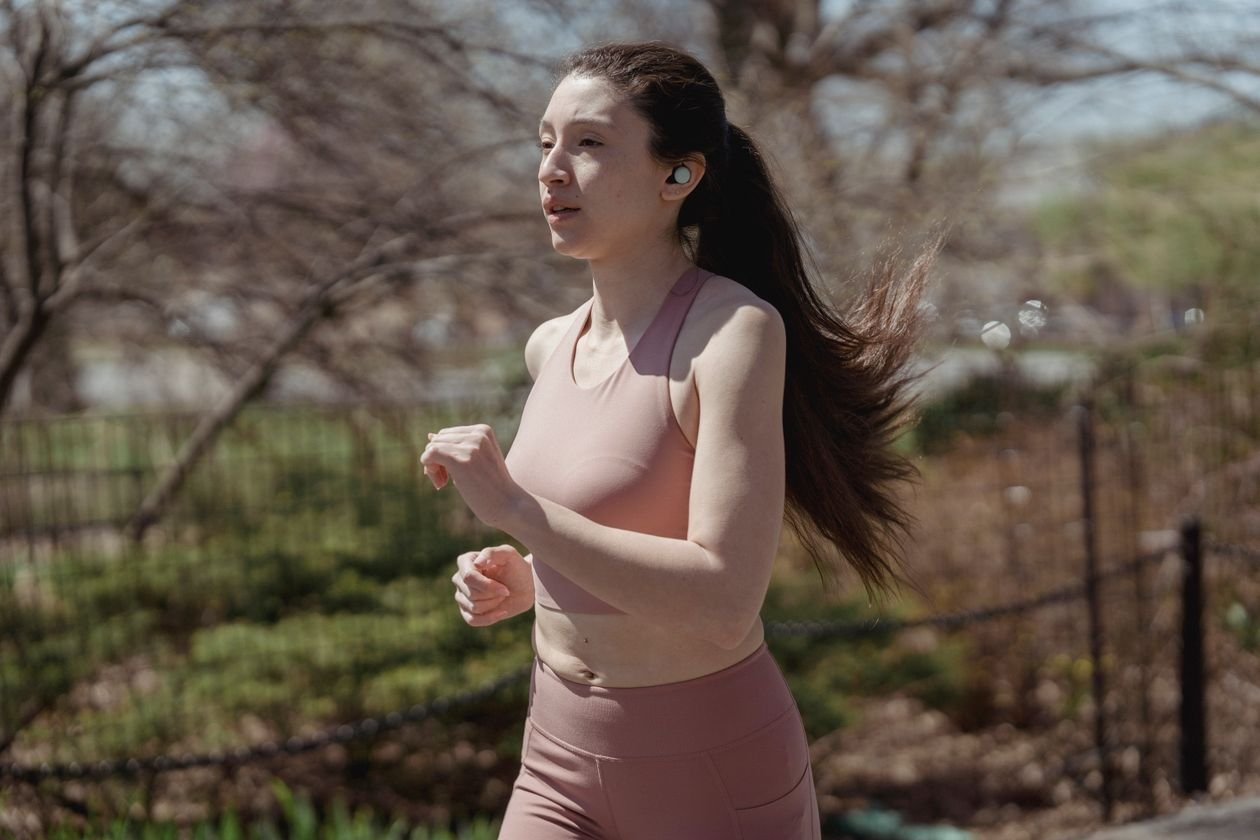
You are three miles into a run, your breathing has settled into a rhythm, and then it happens. One earbud loosens, slides, and drops onto the pavement. You stop, pick it up, push it back in, and within half a mile it is loose again. If you know how to stop earbuds falling out when running without ear hooks, you can fix this problem with fit and habit changes, not with a new pair of earbuds.
This guide is for runners who do not want ear hooks, wings that dig in, or a headband that feels like a helmet. It covers why earbuds slip, how to get a proper seal, and a set of fixes you can test on your next run. Most of these fixes cost nothing. The few that cost money cost less than a replacement pair.
Why earbuds fall out when you run
Running is not like sitting at a desk. Every stride sends a small jolt through your body, your jaw moves as you breathe, and sweat builds up inside your ear. Each of those forces works against the seal that holds an earbud in place.
The seal matters more than most runners realise. An earbud stays put because the tip grips the inside of your ear canal and creates gentle suction. When sweat breaks that grip, or when a cable tugs from below, the seal fails and the bud walks its way out. Pushing the bud in harder does not solve this. It usually makes the fit worse, because a tip that is jammed in at the wrong angle pops out even faster once you start moving.
Ear shape plays a part too. Ear canals are not all the same size, and the left and right ears of one person often differ. That is why a tip size that feels perfect in one ear can feel loose in the other. If you have always used the medium tips that came in the box, there is a good chance that at least one ear needs a different size.
Finally, weight matters. A heavy earbud with a long stem acts like a tiny lever. Every bounce pulls on it. Lighter buds, or buds worn so the cable runs over the ear, put far less strain on the seal. Keep that in mind as you work through the fixes below.
Start with the right tip size, not the default size
Most earbuds ship with three tip sizes in the box. Most runners try the medium pair once and never touch the other two. That is the single most common reason earbuds fall out on a run.
Test each size properly. Put a pair in, play music with some bass, and jog in place for thirty seconds. Then chew, yawn, and shake your head gently from side to side. A good tip will stay put through all of that and will keep the bass sounding full. A tip that is too small will feel loose and will let outside noise leak in. A tip that is too large will ache after a few minutes and will slowly work its way out as your ear pushes back against it.
Try mixed sizes without embarrassment. Many runners wear a large tip in one ear and a medium tip in the other. The box gives you spares for a reason, and nobody can see which size you are wearing. Write down the combination that works, so you can replace it quickly when a tip wears out.

Check your tips every few weeks. Silicone tips stretch and smooth out with use, and a tip that gripped well in spring may be too slick by autumn. If a tip looks shiny, torn, or flattened, replace it. A fresh pair of tips can feel like a completely different earbud.
Try foam tips for a grip that silicone cannot match
If silicone tips still slip once you sweat, foam tips are the next step. Foam tips are made from memory foam that you squeeze, insert, and let expand inside your ear. As the foam expands it fills the shape of your canal, which gives a much stronger grip than a smooth silicone tip.
Foam also handles sweat better in one important way. Silicone gets slippery when wet, while foam keeps its texture and stays in contact with the skin. Runners who lose silicone buds at mile two often find that foam buds stay put for a whole long run.
There are two trade offs to know about. Foam tips wear out faster, so you will replace them every month or two if you run often. They also need a moment to expand, so you cannot just jam them in and sprint off. Squeeze, insert, hold for a few seconds while the foam expands, and then test the seal before you start.
Buy foam tips made for your exact earbud model if you can. Generic foam tips work, but a tip with the wrong inner diameter can slide off the nozzle mid run. That is a worse problem than the one you started with, so check the fit at home before you trust it on the road.
Insert earbuds the way runners do, not the way the box shows
The quick push in method works fine on the sofa. On a run it fails. A better insertion takes ten seconds and makes a real difference.
First, pull your earlobe gently down and slightly back with the opposite hand. This straightens the ear canal for a moment and lets the tip slide in further. Then aim the nozzle slightly forward, toward your nose, rather than straight in. The ear canal angles forward, and a tip aimed straight in will sit shallow and pop out.
Once the tip is in, twist the bud back a little, toward the back of your head, until it settles into the bowl of your outer ear. You should feel it lock in rather than just sit there. Play a low note or a bass heavy song and check that the sound is full. Weak bass usually means a weak seal, so reposition and try again.
Finish with a movement test before you leave the house. Jog in place, chew a few times, and shake your head. If a bud moves, fix it now. It will only move more once sweat and stride join in.
Fix the cable pull that drags buds out
If you run with wired earbuds, the cable is often the real culprit. A cable hanging straight down from your ears swings with every stride, and that swinging tugs the buds downward. Route the cable over your ears instead. Loop each side up and over the top of the ear, so the cable rests behind the ear and runs down your back. This takes the bounce out of the cable and stops it pulling on the buds.
Next, remove slack. Clip the cable to the back of your shirt with a small clip, or run it under your shirt so it cannot swing freely. Some runners thread the cable through a shirt loop or use a tiny safety pin to hold it in place. The goal is simple: the cable should move with your body, not swing against it.
For wireless earbuds the equivalent problem is a loose stem catching on a hood or a collar. If you run in a jacket with a high collar, check that the collar is not brushing the buds with every stride. A small adjustment to the collar, or a buff worn lower on the neck, can stop a surprising number of drops. Wireless dropouts follow a similar pattern in other gadgets, and our guide on why a TV keeps disconnecting from WiFi explains how interference breaks a wireless link.
A related tip from runners who also fight dropouts at a desk is worth remembering. If your laptop keeps losing its connection, the same habit of checking placement and interference first applies, and our guide on keeping a laptop cool on a bed shows how small placement changes solve big annoyances. Placement, not new gear, is usually the answer.

Use a sweatband or buff as a gentle anchor
A thin sweatband or a buff worn over the ears is one of the simplest fixes for runners who do not want ear hooks. The fabric presses lightly against the buds and stops them sliding out, without the pressure of a tight headband.
In cold weather this is easy, since a beanie or an ear warmer does the same job. In warm weather choose a thin, breathable buff and wear it as a wide band across the ears. It will also catch sweat before it reaches the ear, which helps the seal last longer.
Test the fabric on a short run first. A band that is too tight will ache and will push the buds at a bad angle. A band that is too loose will slide up and do nothing. You want a gentle hold that you forget about after the first mile.

One caution: do not wear a band so thick that you cannot hear traffic. Road safety comes first. If you run on roads, keep one ear open to traffic or use a single earbud on the side away from the road. A secure fit is never worth a blind run through traffic.
Manage sweat before it breaks the seal
Sweat is the enemy of a silicone seal. You cannot stop sweating, but you can slow the moment when sweat breaks the grip.
Start with clean, dry ears and clean tips. Oils and old sweat on a tip make it slippery from the first step. Wipe tips with a dry cloth before a run, and wash silicone tips in warm soapy water once a week. Let them dry fully before you use them again.
On hot days, a quick wipe of the outer ear with a dry towel at a water stop can reset the seal. Push the bud back in with the twist method described above, and you may get several more miles from the same fit. Some runners also keep a spare pair of tips in a pocket for long runs, so a slick tip can be swapped rather than fought with.
If sweat is a constant problem, foam tips plus a sweatband together usually solve it. Foam grips when wet, and the band stops the bud travelling even if the seal loosens for a moment. That combination has saved many runners from buying a whole new pair.
Test your fit with a two minute routine
Do this routine once, and you will know which fixes you actually need. It takes two minutes and it prevents a lot of mid run frustration.
First, fit both buds with your chosen tips and do the movement test at home: jog in place, chew, shake your head, and bend forward as if tying a shoe. Note which side moves, if any. Second, walk briskly around the block for two minutes, then check again. Third, run for five minutes at an easy pace and check a final time.
If a bud only fails at the running stage, the problem is bounce or cable pull, not tip size. If it fails at the walking stage, the tip size or insertion angle is wrong. If one side always fails, try a different tip size on that side only. This small bit of diagnosis stops you buying accessories you do not need.
Keep a note of what works in your phone. Tip size per ear, foam or silicone, cable route, and whether a sweatband helped. When you buy new earbuds, that note will save you weeks of trial and error.
When a different design is the honest answer
Sometimes the honest answer is that a particular earbud shape does not suit your ears. Some people have shallow ear bowls or narrow canals that make a standard bud shape a poor match, no matter which tip you try. If you have tested three tip sizes, tried foam, fixed the cable, and still lose a bud every run, it is time to consider a different design.
Bone conduction headphones sit outside the ear and leave the ear canal open, so there is nothing to fall out and you can still hear traffic. They sound different from earbuds, with less bass, but many road runners prefer them for safety alone. Open ear clip designs are another option: they clip gently to the outer ear without going into the canal, and they do not use the ear hook style you want to avoid.
Before you spend money, borrow a pair if you can, or buy from a shop with a good return policy. Wear them on a real run, not just around the shop. A design that feels fine standing still can still bounce loose at pace, and only a run will tell you.
For most runners, though, a new pair is not needed. The fixes in this guide solve the problem for the large majority of people, because the problem was never the earbud itself. It was the fit, the tip, or the cable.
Quick checklist for your next run
Use this checklist before you head out, and your earbuds should stay where they belong.
Check tip size in each ear separately, and replace worn tips. Insert with the pull, aim forward, and twist into place. Route wired cables over the ears and clip away slack. Wear a thin sweatband on hot or long runs. Wipe tips clean and dry before you start. Test with jogging in place before you leave the house.
If a bud still slips, change one thing at a time. Change the tip size first, then the insertion method, then add a sweatband. Changing everything at once makes it impossible to know what actually worked, and you may end up repeating a fix that was never helping.
Conclusion
Learning how to stop earbuds falling out when running without ear hooks comes down to three things: a tip that matches each ear, an insertion that respects the shape of the ear canal, and a cable or sweat plan that stops outside forces pulling the bud loose. Foam tips, a sweatband, and the over ear cable route cover most cases, and a two minute fit test tells you which of them you actually need.
Try the tip size test on your next run. It costs nothing, it takes two minutes, and for many runners it is the whole fix. If that does not do it, work through the rest of the guide one fix at a time. Your music should stay in your ears for the whole run, not on the pavement at mile three.
Frequently asked questions
Why do my earbuds fall out only when I run, not when I walk? Running adds bounce, jaw movement, and sweat all at once. Walking tests none of those forces properly, so a fit that feels fine on a walk can fail within a mile of running.
Are foam tips better than silicone tips for running? For most runners, yes. Foam expands to fill the ear canal and grips better when wet, while silicone gets slippery with sweat. Foam wears out faster, so replace it every month or two.
Can I wear different tip sizes in each ear? Yes, and many runners should. Left and right ears often differ in size, so a large tip on one side and a medium tip on the other is completely normal.
Does a sweatband really keep earbuds in place? A thin sweatband adds a gentle hold and catches sweat before it breaks the seal. It works best alongside a good tip fit, not as a replacement for one.
Should I just buy earbuds with ear hooks instead? Only if you have tried tip sizes, foam tips, insertion fixes, and cable routing first. Many runners solve the problem without hooks, and a new pair is only the answer when the shape itself does not suit your ears.
