
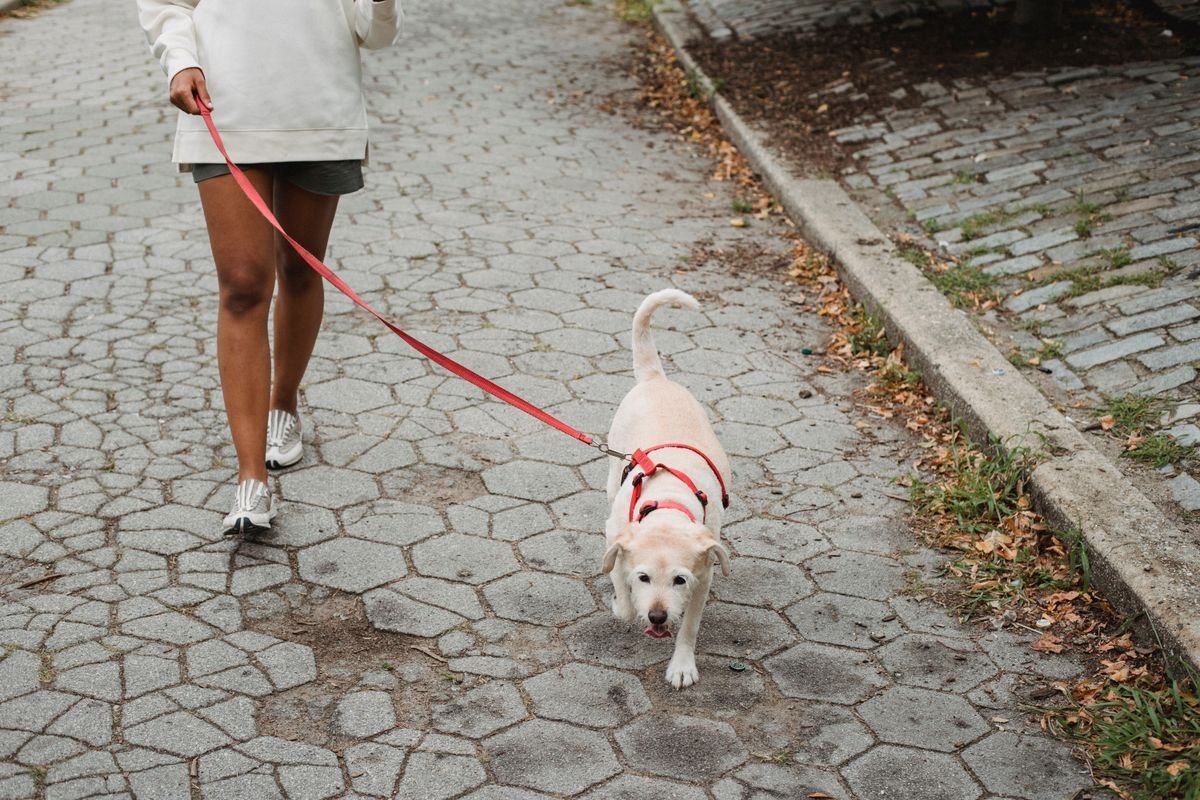
Every dog owner knows the feeling. You clip on the lead, open the front door, and within ten seconds your arm is stretched out in front of you while your dog surges ahead like a small steam train. The walk that should be the best part of the day turns into a daily tug of war, and by the time you get home your shoulder aches, your patience is gone, and your dog has learned nothing except that pulling works. If that sounds familiar, this guide is for you. Learning how to stop a dog from pulling on the lead is not about strength, shouting, or buying an expensive gadget. It is about changing one simple habit, and then repeating the new habit until it becomes the easy choice for your dog.
The good news is that almost every dog can learn to walk on a loose lead. Puppies learn it fastest, because they have not yet practised pulling for months or years, but older dogs can learn it too. Strong dogs, excited dogs, nervous dogs, and dogs that have pulled for years can all improve with the same five rules. You do not need a special breed, a special collar, or hours of free time. You need short daily sessions, a pocket full of treats, and the willingness to stop moving every single time the lead goes tight.
This guide gives you the full plan. You will learn why dogs pull in the first place, the five rules that fix it, the equipment that helps and the equipment that does not, a simple week by week plan, and how to deal with the problems that most owners run into, from a dog that lunges at squirrels to a puppy that plants its feet and refuses to move. Follow the rules on every walk and most owners see a real change within two to four weeks.
Why Dogs Pull on the Lead
Dogs do not pull to annoy you. They pull because pulling works. Think about it from your dog’s point of view. Your dog sees something interesting ahead, a smell, another dog, a person, a patch of grass, and walks towards it. The lead goes tight. You follow. Your dog reaches the interesting thing. In your dog’s mind, pulling got the reward. Every step forward on a tight lead teaches your dog the same lesson again: pull harder and you get where you want to go.
That is why shouting, jerking the lead, or dragging your dog back rarely fixes the problem. Your dog is not being stubborn or dominant. Your dog is doing the thing that has always paid off. The only way to change the behaviour is to change what pays off. When the lead is tight, nothing good happens. When the lead is loose, good things happen. Once your dog understands that simple deal, walking nicely becomes the obvious choice.
There are a few other reasons dogs pull, and it helps to know which one is driving your dog. Excitement is the most common. Young dogs and friendly dogs pull because the world is wonderful and they want to get to all of it at once. Fear is another. A nervous dog may pull to get away from something scary, or pull towards home when it wants the walk to end. Some dogs pull because they have never been taught anything else. If nobody ever showed a dog where to walk, the dog simply walks at its own speed, and most dogs walk faster than people do. And some dogs pull because the walk is the only exciting part of their day, so all of their energy comes out in the first five minutes.
None of these reasons means your dog is a bad dog. They all mean the same thing: your dog needs clear, calm, consistent teaching. That is what the five rules below give you.
What Loose Lead Walking Really Looks Like
Before you start, it helps to know what you are aiming for. Loose lead walking does not mean your dog must march at your heel with its nose glued to your leg. That is heel work, and it is a different skill, useful for crossing roads and passing other dogs, but far too strict for a whole walk. Loose lead walking simply means the lead hangs in a soft curve, like the letter U, with no tension on it. Your dog can be a step ahead, a step behind, or beside you. Your dog can sniff and look around. The only rule is that the lead stays loose.
That picture matters, because it makes the training fair. You are not asking your dog to be a robot. You are asking for one thing only: do not pull me. When you keep the goal that simple, your dog can succeed, and success is what builds a habit.
How to Stop a Dog From Pulling on the Lead in Five Simple Rules
The five rules below are the whole method. They look simple, and they are, but simple does not mean easy. The hard part is doing them every single time, on every walk, even when you are in a hurry or it is raining. Dogs learn from what happens every time, not from what happens most of the time. If pulling works even one walk in five, your dog will keep trying it. If pulling never works, your dog will stop trying it. That is the deal, and it is the reason this method works when gadgets and shouting do not.
Rule 1: A Tight Lead Stops the Walk
This is the most important rule, and it is the one that does most of the work. The moment the lead goes tight, you stop. You do not pull back. You do not say anything. You simply become a tree. Stand still, keep your feet planted, and wait. Your dog will probably keep pulling for a few seconds, then look back, or step back, or turn towards you. The instant the lead goes slack, even by a few centimetres, you start walking again.
Do this every single time the lead tightens, without exception. At first you will stop a lot. Your first walks may feel like you are spending more time standing still than walking, and that is normal. You are not wasting the walk. Every stop is a lesson. Your dog is learning that pulling makes the world stop, and that a loose lead makes the world move again.
There are two details that make this rule work. First, keep your body relaxed when you stop. If you lean back and brace yourself, you turn the stop into a tug of war, and your dog will pull harder. Stand upright, let the lead go slack in your hand, and wait. Second, do not repeat the stop as a punishment. You are not angry. You are simply boring. The world only moves when the lead is loose, and that is a fact your dog can learn in days.
Some trainers call this the stop and stand method, and it is the single most recommended technique in the UK for a reason. It needs no equipment, no shouting, and no strength. It works on a terrier and it works on a Great Dane, because it works on the same simple logic for every dog: pulling never gets you anywhere.
Rule 2: Reward the Position You Want
Dogs repeat what pays. If you only notice your dog when it pulls, your dog learns that pulling gets your attention. So flip it around. Reward your dog for being where you want it to be. When your dog is walking beside you, or even a step behind you, with a loose lead, say a cheerful word such as yes and give a small treat. Do this often at first, every few steps if you need to. You are paying your dog for the right position, and dogs are very good at working out where the pay is.
Keep the treats small and easy to eat, the size of a pea is plenty, and keep them in a pocket or a treat pouch on the same side as your dog. If you fumble for a treat for ten seconds every time, the moment is gone. If you use a clicker, click the instant the lead is loose and your dog is in a good spot, then treat. If you do not use a clicker, a short marker word such as yes works just as well, as long as you use the same word every time.
As your dog improves, you can slowly space the rewards out. Start by rewarding every few steps, then every ten steps, then once or twice a minute, then only now and again. Do not rush this. If you stop rewarding too soon, the behaviour fades. Most owners make the mistake of rewarding too little, not too much. Keep paying for good walking for at least a month, and your dog will keep offering it.
Reward position is also the reason your treats matter. Use something your dog genuinely loves, such as small pieces of chicken, cheese, or a favourite shop bought treat. Dry kibble is fine for a calm dog on a quiet street, but for a dog that is excited or distracted, you need something worth working for. If your dog will not take a treat outside, the world is too exciting or too scary for training right now, and you need to start somewhere quieter. More on that in the section about where to practise.

Rule 3: Change Direction Before the Pull Starts
Stopping works, but it is even better to stop the pull before it happens. Watch your dog. You will start to see the signs: the ears go forward, the body leans, the pace quickens, the lead starts to straighten. The moment you see that, before the lead goes tight, turn around and walk the other way. Calmly, without a word, just turn and go.
Your dog will follow, because the lead is still loose and there is nothing to pull against. After a few steps, turn again and walk in your original direction. Each turn teaches your dog the same lesson as stopping, but it keeps you moving, and it teaches your dog to pay attention to you instead of charging ahead. This is the change direction method, and it is especially useful for dogs that pull hard and fast, where stopping alone feels like a battle.
It helps to practise this in a quiet place first, such as a garden or an empty car park, where there is nothing exciting to pull towards. Walk in straight lines, turn when your dog moves ahead of you, and reward your dog when it catches up and the lead goes loose. Once your dog is turning with you smoothly in a quiet place, take the same game onto a quiet street.
One common mistake is to turn too late, after the lead is already tight. At that point, turning just drags your dog around, and the lesson is lost. Turn early, when you see the pull coming. If you miss the moment, stop instead, wait for slack, and then walk on. The two rules work together: stop when the lead is tight, turn when you can see it about to tighten.
Rule 4: Start Easy and Build Up Slowly
Most owners try to train loose lead walking on the hardest walk of the day, down a busy street full of dogs, people, smells, and traffic. That is like learning to drive on a motorway. Start somewhere easy and build up slowly.
Begin in your garden or inside the house, where there are few distractions. Then move to a quiet street or a quiet corner of a park. Then a busier street. Then the places your dog finds hardest, such as the route to the park, or the street where the neighbour’s cat lives. Only move to the next level when your dog can walk nicely at the current level most of the time. If your dog falls apart at a new level, go back a step. That is not failure. That is good training.
This rule also applies to time. Keep training sessions short, five to ten minutes of focused work, then let your dog have a relaxed sniffy walk or a play. A tired dog learns better than an exhausted one, and a short good session beats a long frustrating one. Two short sessions a day will get you further than one long battle.
It also helps to train when your dog is calm. A dog that has been asleep all morning and is bursting with energy will find it much harder to walk nicely than a dog that has had a game in the garden first. If you can, play with your dog or let it run around the garden for ten minutes before a training walk. You are not trying to tire your dog out completely. You are just taking the edge off, so your dog can think.
Rule 5: Practise the Same Rules on Every Walk
The final rule is the one that holds the other four together. Every person who walks the dog must follow the same rules. If you stop when the lead goes tight but your partner lets the dog pull to the park, your dog learns that pulling works sometimes, and sometimes is enough to keep the habit alive. Sit down with everyone in the house, agree the rules, and stick to them.
The same applies to you on a bad day. It is tempting to let the dog pull just this once because you are late, or tired, or it is raining. But your dog cannot tell the difference between a rule and a sometimes rule. If pulling works on rainy days, your dog will pull on rainy days, and then on dry days too, just in case. The fastest way to fix pulling is to make the rules boringly consistent.
That does not mean every walk must be a training session. You can give your dog free time on a long lead in a field, or let it run off the lead where it is safe and legal to do so. But on a normal lead, on a normal walk, the rules apply every time. Within a few weeks, you will find you do not have to think about them any more. Stopping, rewarding, and turning will have become habits for you too, and your dog will have learned that walking beside you is the best deal on offer.
Equipment That Helps, and What It Cannot Do
No piece of equipment teaches a dog to walk nicely on its own. Equipment can make training easier, or make it harder, but the training is what changes the behaviour. That said, the right lead and harness can make your life much easier while you train.
Start with the lead. A standard flat lead of 1.5 to 2 metres is ideal for most dogs. It gives your dog room to walk beside you and sniff, without giving so much room that your dog can build up speed and hit the end of it at a run. Avoid retractable leads while you are training, because they teach your dog that the lead length changes all the time, and they make it almost impossible to feel when the lead is tight or loose. A fixed length lead gives you and your dog clear, honest information.
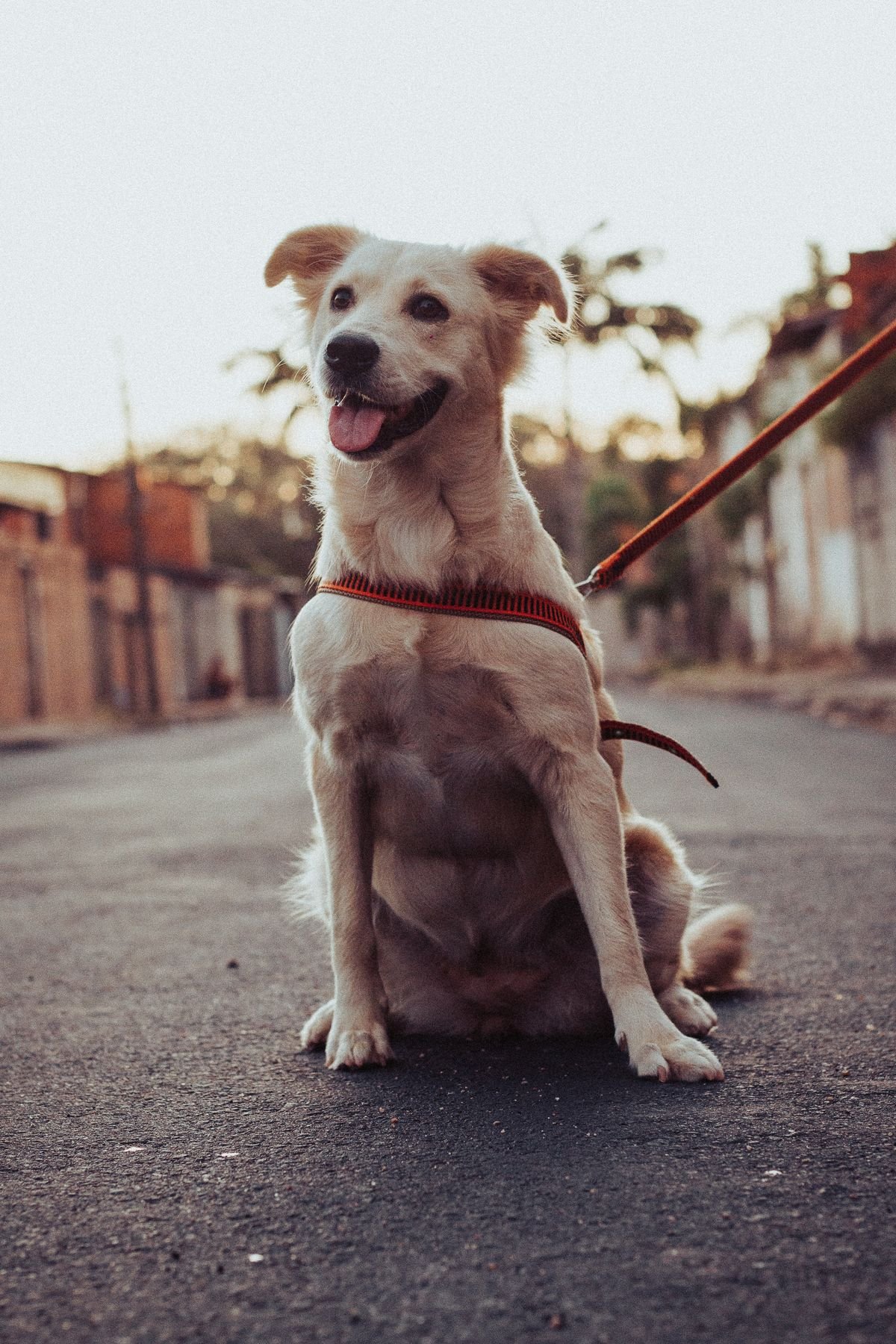
A well fitted harness is a good choice for most dogs, and it is kinder than a collar for a dog that pulls, because it spreads the pressure across the chest instead of the neck. A front clip harness, where the lead attaches at the chest, can help a strong puller, because it gently turns the dog towards you when it pulls. A back clip harness is fine for a dog that already walks fairly well. What matters most is the fit: you should be able to slide two fingers under every strap, and the harness should not rub under the legs or slip sideways.
A head collar can help with a very strong dog, but it is not a magic fix, and it needs careful introduction. Most dogs hate the feeling at first, and you need to spend a few days pairing it with treats before you ever use it on a walk. If you are unsure, ask a local trainer to show you how to fit and introduce one. Never use a choke chain or a prong collar. They work by causing pain, they can injure your dog’s neck, and they teach your dog that walks are frightening, which makes pulling and other problems worse, not better.
Whatever you use, remember the limit. A harness or a head collar manages pulling. Only training stops it. If you buy a new harness and keep letting your dog pull, you will have a dog that pulls in a more expensive harness. Spend your money on treats and your time on the five rules, and the equipment becomes a helper, not a hope.
A Simple Week by Week Plan
Having a plan helps, because it tells you what to do each day and stops you from trying to fix everything at once. The plan below works for most dogs. Some dogs move faster, some slower, and that is fine. Move to the next week when your dog is getting it right most of the time, not when the calendar says so.
Week 1: Teach the Deal at Home
Start in your garden or a quiet room. Hold a treat in your hand, take a few steps, and reward your dog for walking beside you with a loose lead. Practise stopping the moment the lead goes tight, and starting again the moment it goes slack. Keep sessions to five minutes, two or three times a day. Your only goal this week is for your dog to learn the basic deal: tight lead means stop, loose lead means go and treats appear.
By the end of the week, most dogs understand the game indoors. They may still forget it outside, where the world is far more interesting, and that is completely normal.
Week 2: Take It to a Quiet Street
Move your short sessions onto a quiet street or a quiet corner of a park. Keep them short, five to ten minutes, and keep rewarding generously. Expect your dog to be worse here than it was at home. That is not your dog being naughty. It is your dog telling you the new place is harder. Stay at this level until your dog can walk a short stretch with a mostly loose lead.
If you meet another dog or something exciting, create distance. Cross the road, step to one side, and let the distraction pass. Do not try to train through a big distraction in week two. You are building a habit, and habits are built on success.
Week 3: Add Real Life
Now start using the rules on normal walks. Pick your easiest walk of the day for training, and keep the other walks relaxed. Add gentle challenges, such as walking past a parked car, a person on a bicycle, or a dog across the street. Keep rewarding good position, and keep turning before the pull starts. If your dog has a bad walk, do not worry. Go back to a quieter place for a day and rebuild.
Week 4 and Beyond: Make It Normal
By now most dogs walk nicely on familiar routes, though they may still pull when something very exciting appears. Keep going. Start to space out the treats, reward with praise and the chance to sniff as well as food, and take the rules onto harder routes. Most owners see a real, lasting change within two to four weeks of consistent work, and a fully reliable loose lead walk within six to eight weeks. Strong pullers and dogs that have pulled for years can take a little longer, and that is fine. You are changing a habit that may have had years to build.
Troubleshooting: When It Is Not Working
Most training problems have a simple cause. Work through the list below before you decide the method is not working. In almost every case, one of these is the answer.
Your Dog Pulls Like a Train
If your dog is strong and pulls hard, start in the easiest place you can find, even if that is just your hallway or garden. Use a front clip harness to take the power out of the pull, and reward every few steps. If you cannot hold your dog safely, ask a trainer for help in person. There is no shame in that. A strong dog can injure your shoulder, and a trainer can show you in minutes what takes weeks to work out from reading alone.
Also check your dog’s exercise. A dog that pulls hardest in the first ten minutes of a walk is often a dog with energy to burn. A game of fetch in the garden, or a few minutes of training at home before you leave, can take the edge off and make the walk much easier.
Your Dog Lunges at Other Dogs or Squirrels
Lunging is pulling with a target, and it needs the same rules plus distance. When you see another dog ahead, move away before your dog reacts. Cross the road, turn into a side street, or step behind a parked car. Reward your dog for looking at you instead of the other dog. Over time, your dog learns that other dogs are a cue to look at you, not to lunge.
If your dog lunges at everything and you cannot get any distance, you may be walking in places that are too busy for training. Choose quieter routes and quieter times of day until your dog can cope. Early mornings are often much easier than the school run.
Your Puppy Plants Its Feet and Refuses to Move
Some puppies do the opposite of pulling: they sit down and refuse to budge. This is usually fear or tiredness, not stubbornness. Never drag a puppy. Crouch down, speak gently, and use a treat to lure it a few steps. If it will not move, pick it up and carry it a short way, or go home. A puppy that is frightened needs reassurance, not pressure. Short, happy walks build confidence, and confidence is what stops the freezing.
You Stop, but Your Dog Just Keeps Pulling
Some dogs will pull against a stopped owner for a long time, especially if pulling has always worked. Wait it out. Stand still, stay relaxed, and do not say a word. The moment the lead goes slack, even a little, walk on. The first few times may take a minute or more. That is fine. Your dog is testing whether the new rule is real. Once it learns that it is, the waiting gets shorter every day.
If your dog never gives you any slack at all, try turning instead of stopping. A turn breaks the pulling pattern and gives your dog a reason to follow you. You can also try walking backwards a few steps, which often makes a dog turn towards you. Reward the instant the lead loosens.
Your Dog Is Perfect at Home and Terrible Outside
This is the most common complaint, and it has the simplest answer: outside is harder, so train outside. Your dog has not failed. You have simply jumped ahead too fast. Go back to the easiest outdoor place you can find, a quiet road or an empty car park, and rebuild there. Progress is not a straight line, and going back a step is part of good training, not a sign of failure.
Common Mistakes That Slow You Down
Avoiding these mistakes will save you weeks of frustration.
- Letting the dog pull sometimes. If pulling works on the way to the park but not on the way home, your dog will keep pulling on the way to the park. Consistency is the whole method.
- Walking too far, too soon. Long walks in exciting places are too hard for a dog that is still learning. Keep training walks short and finish on a success.
- Using a retractable lead. It rewards pulling by letting the dog go further, and it makes the tight or loose signal impossible to feel.
- Shouting or jerking the lead. It frightens your dog, damages trust, and does nothing to teach the right behaviour.
- Forgetting to reward. If good walking never pays, your dog has no reason to offer it. Keep treats in your pocket for at least a month.
- Training when your dog is overexcited. Take the edge off with play first, or train at a quieter time of day.
- Expecting perfection in a week. Most dogs need two to four weeks to show a real change and six to eight weeks to make it reliable. That is normal, and it is worth it.
Beyond the Walk: A Calmer Home Helps Too
Lead training works best when the rest of your dog’s life is calm and settled. A dog that gets enough sleep, enough play, and enough mental stimulation is far easier to train than a dog that is bored or overtired. Give your dog a comfortable place to rest, a few minutes of training games each day, and a chew or a puzzle feeder to work on. A tired mind is just as important as a tired body.
And remember that training does not end at the front door. The same calm, reward based approach works for everything else your dog is learning, from settling on a mat to greeting visitors politely. If your dog sheds all over the sofa after a muddy walk, our guide to pet hair will help you clean up in minutes. And if you share your home with a cat as well, you may find our guide to cats scratching furniture useful for keeping the peace between your pets and your furniture.

Conclusion: Five Rules, One Calmer Walk
Learning how to stop a dog from pulling on the lead comes down to five simple rules. Stop when the lead goes tight. Reward the position you want. Change direction before the pull starts. Start easy and build up slowly. And follow the same rules on every walk. None of them needs strength, shouting, or expensive equipment. All of them need consistency, and that is the part only you can provide.
Start today, in your garden or on a quiet street, with a pocket full of treats and a five minute session. Stop when the lead tightens, reward when it stays loose, and turn before the pull starts. Do the same thing tomorrow, and the day after. Within two to four weeks you should see a real difference, and within six to eight weeks loose lead walking can become your dog’s normal habit, not a special trick.
Your dog is not pulling to upset you. Your dog is pulling because it has always worked. Change what works, and you change the walk. The best part of the day is waiting for you both, at the end of a loose lead.
Frequently Asked Questions
How long does it take to stop a dog from pulling on the lead?
Most owners see a real improvement within two to four weeks of consistent daily practice, with a reliable loose lead walk taking six to eight weeks. Dogs that have pulled for years, or very strong and excitable dogs, can take a little longer.
Does a harness stop a dog from pulling?
No harness stops pulling on its own. A well fitted harness, especially a front clip harness, can make pulling easier to manage and kinder on your dog, but only training changes the habit. Use the harness as a helper alongside the five rules, not as a replacement for them.
What lead length is best for loose lead training?
A standard flat lead of 1.5 to 2 metres is ideal. It gives your dog room to walk beside you and sniff, without letting it build up speed. Avoid retractable leads while training, because they make the tight or loose signal impossible to feel.
Can an older dog learn to stop pulling on the lead?
Yes. Older dogs can learn just as well as puppies, and sometimes faster, because they are calmer and more focused. The method is the same: stop when the lead is tight, reward loose lead walking, and be consistent. A dog that has pulled for years may need a few extra weeks, but it can still learn.
Should I use a head collar for a dog that pulls?
A head collar can help with a very strong dog, but it needs careful introduction with treats over several days, and it does not replace training. If you are unsure, ask a local trainer to show you how to fit it and introduce it. Never use a choke chain or a prong collar, as they can injure your dog and make walks frightening.
