

Why “What Do You Want to Eat” Is the Hardest Question of the Day
You open your phone, type food near me, and stare at a wall of pins on a map. Dozens of options appear in seconds, yet somehow the decision feels harder than it did with fewer choices. This is not a coincidence. Psychologists call it choice overload, and it hits hardest when you are hungry, tired, and trying to please more than one person at the table.
The truth is that searching for food near me was never really the problem. The search engine does its job well. The real challenge is what happens after the results load: too many tabs, too many opinions, and no clear way to filter through them quickly.
This guide is built to solve that second part. Instead of just listing restaurants, it gives you a repeatable way to think through the decision, whether you are eating alone, feeding a family, or trying to settle an argument between four hungry coworkers on a lunch break.
Start With Constraints, Not Cravings
Most people begin the search for food near me by asking “what am I craving.” That question sounds reasonable, but it is often the reason the decision drags on. Cravings are vague and they shift the moment someone suggests an alternative.
A faster approach is to start with constraints instead. Constraints are specific, they are easy to agree on, and they narrow the field immediately.
Useful constraints to settle first include:
- How much time do you actually have before you need to eat
- What is the realistic budget per person
- Is this for one person, a couple, or a group
- Does anyone have a dietary restriction that rules out entire categories
- Do you want to sit down, or do you need something fast
Once these five questions are answered, the list of realistic options for food near me usually shrinks from fifty places to five. Only then does it make sense to ask what sounds good, because now every remaining option already fits your situation.
The Five Minute Decision Framework
If you have ever spent longer choosing a restaurant than you spent eating at it, this framework is for you. It is designed to take a group or an individual from open question to final decision in about five minutes.
Step One: Set a Hard Time Limit
Give the decision a clock. Two minutes to gather opinions, two minutes to narrow the list, one minute to commit. A visible countdown, even an informal one, stops the conversation from looping.
Step Two: Collect Categories, Not Restaurants
Instead of naming specific restaurants right away, ask everyone to name a food category: tacos, pizza, sushi, burgers, and so on. Categories are less personal than specific brands, so people tend to agree faster.
Step Three: Eliminate, Do Not Debate
Once you have three or four categories, eliminate rather than argue. Ask who genuinely cannot eat a given category today, and remove it. Do not ask who prefers it over another, because that reopens debate.
Step Four: Search and Filter
With one category left, search food near me alongside that category, such as tacos near me or ramen near me. Filter by open now, distance, and rating above four stars if your app supports it.
Step Five: Pick the Top Result and Commit
Choose from the top two or three results and stop scrolling. The tenth option rarely beats the second by enough to justify the extra ten minutes of searching.
How to Search for Food Near Me the Smart Way
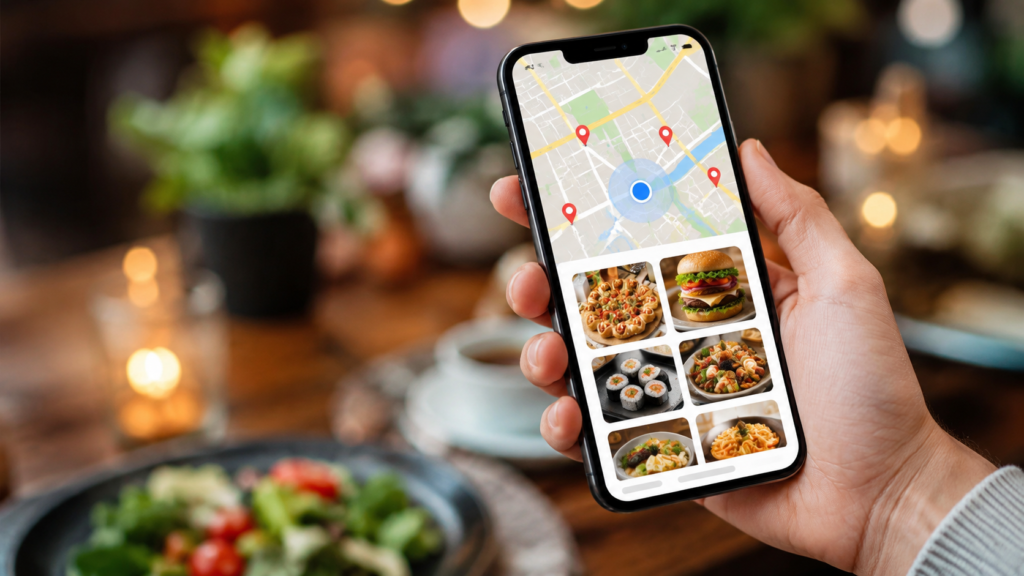
Typing food near me into a map app or search engine gives you a broad list, but a few small adjustments make the results far more useful.
Add a cuisine or dish to the search. A plain search for food near me returns everything, while a search for Thai food near me or best breakfast near me returns something you can actually evaluate.
Filter by open now. Nothing wastes more time than falling in love with a place only to discover it closed twenty minutes ago. Almost every map app has this filter, and it should be one of the first things you check.
Sort by distance when time matters, and by rating when quality matters more than convenience. These two priorities pull in different directions, so decide which one matters more before you start scrolling.
Check the price indicator. Most listings show a rough price range using dollar signs. This single detail can eliminate half the list before you read a single review.
Look at recent photos, not just the highest rated ones. Restaurants change staff, menus, and quality over time. A photo from three years ago tells you less than one uploaded last month.
Reading Reviews Without Getting Fooled by Them
Star ratings are useful, but they can also mislead you if you take them at face value. A restaurant with a 4.8 rating and twelve reviews is a different situation than one with a 4.3 rating and four thousand reviews. The second number is more reliable simply because of sample size.
A few habits make reviews genuinely useful instead of just reassuring:
- Read a handful of three star reviews, since they tend to be the most balanced and specific
- Look for repeated complaints across multiple reviewers, because a single bad experience is not a pattern, but three similar complaints usually are
- Check the date of the most recent reviews to make sure the feedback reflects how the place operates now
- Notice whether the owner responds to negative reviews, which often signals how seriously the business takes customer experience
None of this needs to take more than a minute or two. The goal is not to become a review analyst, it is simply to avoid the two most common mistakes: trusting a tiny sample size, or ignoring a clear pattern because the overall star average still looks fine.
Group Decisions: Solving the “Nobody Cares Until Everyone Disagrees” Problem
Group food decisions have a strange pattern. Nobody wants to choose first, but everyone is ready to reject a suggestion once it is made. This dynamic is exactly why searching food near me as a group often takes longer than doing it alone.
A few techniques break this cycle without anyone feeling steamrolled.
Use a rotation system. If you regularly eat out with the same group, let a different person choose each time. This removes the pressure of finding something everyone loves and replaces it with something everyone can accept for one meal.
Try elimination voting instead of preference voting. Rather than asking what people want, ask each person to veto one option from a shortlist of four. Whatever survives is usually acceptable to the whole group, even if it was nobody’s first choice.
Split when the group is large enough. If six people cannot agree, it is often faster and more satisfying to split into two smaller groups than to force a single compromise that pleases no one fully.
Default to versatile venues when opinions are strongly split. Food courts, restaurants with large varied menus, or places with both meat and vegetarian options nearby can solve a stalemate quickly, since everyone gets to choose something they actually want.
Solo Dining and Quick Lunch Decisions
Not every search for food near me involves a group. Sometimes it is a quick lunch break with fifteen minutes to spare, and the decision needs to be fast and low pressure.
For solo trips, the constraints from earlier still apply, just simplified. Set a time limit, decide on a rough budget, and pick the first option that clears your basic bar for rating and distance. There is no one else to negotiate with, so the five minute framework can often shrink to two.
A useful habit for frequent solo diners is keeping a short mental or written list of three or four reliable go to spots near your usual locations, whether that is home, work, or a place you visit often. This removes decision fatigue entirely on busy days, since you are choosing from a pre-approved shortlist rather than starting from scratch every time.
Delivery vs Pickup vs Dine In: Which Makes Sense Right Now
Once you know what you want to eat, the next decision is how you want to get it. Each option fits a different situation.
Delivery makes sense when you are short on time, do not want to leave the house, or are ordering for a group at an office or event. The tradeoff is a delivery fee, a wait that is usually longer than pickup, and food that may not travel as well depending on the dish.
Pickup is often the fastest and cheapest way to get food near me without cooking. You skip the delivery fee, the food arrives at peak freshness, and many restaurants offer online ordering that lets you skip the line entirely.
Dine in is worth choosing when the experience matters as much as the food itself, such as a celebration, a work meeting, or simply wanting a break from your usual environment. It takes more time, but it also removes the packaging step entirely and often comes with better food quality straight from the kitchen.
A simple rule of thumb: if the food travels well and time is tight, choose pickup. If convenience matters more than cost, choose delivery. If the occasion matters, choose to dine in.
Budget Friendly Ways to Eat Well Nearby
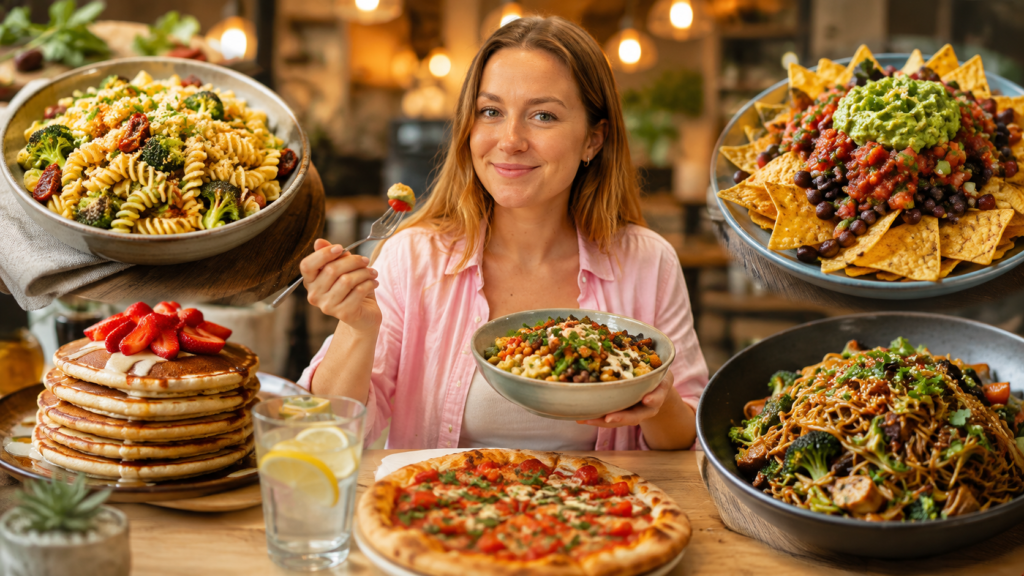
Eating out does not have to be expensive, even when searching something as broad as food near me. A few practical habits stretch a food budget significantly.
Lunch menus are often priced lower than dinner menus at the same restaurant, sometimes by a wide margin, so timing your visit can make a noticeable difference. Many sit down restaurants also offer happy hour pricing on appetizers or drinks during specific hours, which is worth checking before assuming a place is out of budget.
Ordering family style at a restaurant with generous portions can also reduce the per person cost compared to everyone ordering an individual entree. This works particularly well at restaurants that specialize in shareable dishes, such as certain Mediterranean, Chinese, or tapas style menus.
Finally, comparing the same dish across two or three nearby options before deciding can reveal meaningful price differences for what is essentially the same meal, especially with common dishes like pizza, burritos, or noodle bowls where ingredients and portion sizes are fairly standard.
Special Occasions and Dietary Needs
Searching food near me for a specific occasion or dietary requirement benefits from a slightly different approach than a casual meal.
For celebrations, look beyond the star rating and check whether the restaurant accommodates reservations, has private or semi private seating, and can handle group sizes comfortably. Calling ahead, even briefly, often reveals information that listings do not show, such as whether they can set up a small celebration or accommodate a specific timing request.
For dietary restrictions, filtering directly by need, such as searching vegetarian food near me or gluten free food near me, saves significant time compared to filtering a general list manually. Many restaurant listings now include dietary tags, and reading the most recent reviews from people with the same restriction often gives more reliable guidance than the menu description alone, since kitchens vary in how carefully they handle cross contamination or ingredient substitutions.
Building a Personal Shortlist So You Never Start From Zero
The single biggest time saver for repeated searches of food near me is not a better app or a smarter filter. It is simply keeping a running shortlist of places you already trust.
Every time you have a great experience at a nearby restaurant, save it. Most map apps allow you to star, favorite, or add a location to a custom list. Over a few months, this builds into a personal directory that reflects your actual taste rather than a stranger’s average rating.
A well maintained shortlist typically includes a mix of categories: a reliable quick lunch spot, a solid dinner option for two, a place that handles groups well, and one or two spots for special occasions. When the question of where to eat comes up again, you are choosing from a list you already trust instead of researching from scratch.
Final Takeaways
Finding good food near me is rarely about a lack of options. Most areas have more restaurants within a short distance than anyone could try in a year. The real challenge is deciding quickly and confidently without decision fatigue taking over.
Start with constraints like time, budget, and group size before worrying about specific cravings. Use a structured approach for group decisions instead of open ended debate. Read reviews for patterns rather than trusting a single star rating, and choose between delivery, pickup, and dine in based on what the moment actually calls for.
Most importantly, build a shortlist over time. The next time someone asks what sounds good nearby, you will already have an answer ready, and the search for food near me will take seconds instead of twenty minutes of scrolling.
FAQ
How do I quickly decide what to eat when nobody in my group can agree?
Use elimination instead of preference. Ask each person to rule out one option from a short list rather than naming their favorite, since this reaches an acceptable choice much faster than open debate.
Is it better to filter search results for food near me by rating or by distance?
It depends on your priority. Sort by distance when time is limited, and by rating when you have flexibility and want the best possible experience even if it takes slightly longer to get there.
How many reviews should a restaurant have before I trust its star rating?
A rating based on a few dozen reviews or more is generally more reliable than one based on just a handful, since a small number of reviews can be skewed by a single unusually good or bad experience.
What is the fastest way to find budget friendly food near me?
Check for lunch specific menus, which are often priced lower than dinner, and consider restaurants known for shareable or family style dishes if you are ordering for more than one person.
Should I choose delivery or pickup when I am short on time?
Pickup is usually faster overall once you factor in delivery windows, and it also avoids delivery fees, so it tends to be the better choice when speed and cost both matter.
