
Every ballet dancer, from a four year old in their first recital class to a principal dancer on a major stage, begins in exactly the same place: the five basic ballet positions. These positions are not just a starting point for a class. They are the alphabet of ballet, and every jump, turn, and extension is built from them.
If you are new to ballet, or you are the parent of a child who just started lessons, understanding ballet positions will help you follow along, support proper technique at home, and appreciate what is actually happening on stage. This guide walks through each of the five foot positions and their matching arm positions, explains where they come from, and shares practical tips that many beginner guides leave out entirely.
What Are Ballet Positions
Ballet positions are the five standardised stances of the feet and arms that form the foundation of classical ballet technique. They were designed so that every dancer, regardless of where they trained, could move through the same vocabulary of shapes and transitions.
A ballet class almost always begins and ends with these positions. Even the most complex choreography, a grand jeté or a series of fouetté turns, passes through one of the five positions at some point. Learning them properly early on makes every later step easier and safer.
A Short History of the Five Positions
The five basic ballet positions date back to the 1600s. King Louis XIV of France, an enthusiastic dancer himself, established the Académie Royale de Danse in 1661. From there, the dance master Pierre Beauchamp is widely credited with formalising the five positions of the feet that dancers still use today.
This is also why so much ballet vocabulary is in French. Terms like plié, tendu, and port de bras all trace back to this French royal tradition, even though ballet is now taught and performed all over the world, including in strong training traditions here in the UK through organisations like the Royal Academy of Dance.
The Five Basic Foot Positions
Each foot position uses turnout, which means the legs are rotated outward from the hips rather than the ankles or knees. Below is a breakdown of each position and how it should feel and look.
First Position
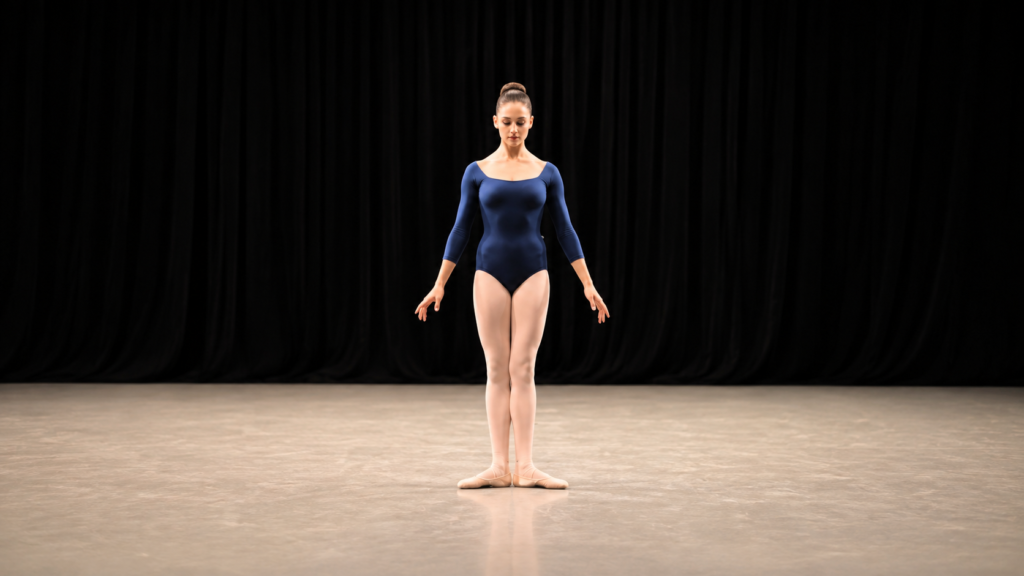
In first position, the heels touch each other while the toes point outward to each side, ideally forming a straight line. The turnout should come from the hips, not from twisting the knees or forcing the ankles.
Beginners often place too much emphasis on how wide their feet turn out, rather than how correctly the rotation happens. It is better to have a smaller, controlled turnout than a wide one that strains the joints.
Second Position
Second position looks similar to first, except the feet are separated by roughly the width of one foot to hip distance apart. The toes remain turned outward, and the weight should be spread evenly between both legs.
This position is commonly used in warm up exercises like pliés and tendus, since it gives dancers a stable, balanced base to work from.
Third Position
Third position places one foot in front of the other, with the heel of the front foot touching the middle of the back foot. It is considered a transitional position and, in modern training, is used far less often than the others.
Many contemporary dancers have such a high degree of turnout that third position looks almost identical to fifth position, which is one reason some studios skip it and move straight from second to fourth and fifth with younger students.
Fourth Position
In fourth position, one foot is placed directly in front of the other with a gap of about one foot’s length between them, and both feet remain turned out. The dancer’s weight should be evenly balanced between the front and back leg.
This position requires strong core control and balance, since the stance is deeper and less symmetrical than first or second. It often shows up before pirouettes, giving the dancer a stable launching point for a turn.
Fifth Position
Fifth position is the most recognisable of the five, and often the one people picture when they imagine a classical ballet pose. The feet are crossed tightly, with the heel of the front foot touching the toe of the back foot.
It takes strong turnout, ankle mobility, and core strength to hold fifth position with good alignment. This is usually the last of the five positions a beginner masters, and it is worth taking time to build up to it gradually rather than forcing the feet into place.
The Five Basic Arm Positions
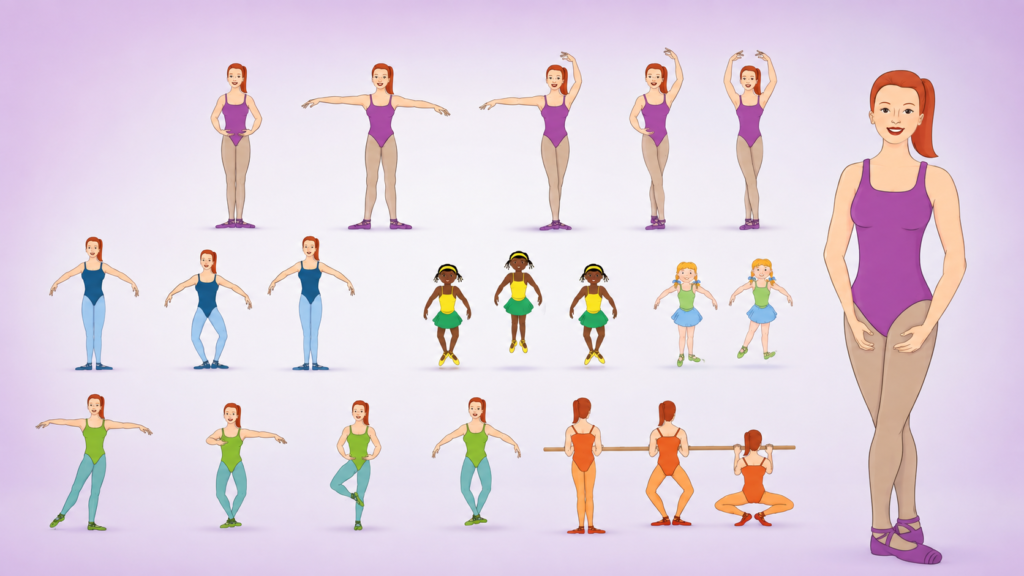
The arm positions, known collectively as port de bras, are just as important as the foot positions, even though they get less attention from beginners. Naming conventions vary slightly between training methods, but the basic shapes are consistent.
- Preparatory position: both arms are lowered and rounded, with the fingers almost meeting in front of the hips.
- First position: the arms lift while keeping their rounded shape, with fingertips roughly level with the navel or lower chest.
- Second position: the arms extend out to the sides, slightly lower than shoulder height, with a soft bend at the elbow and palms facing forward.
- Third position: one arm stays in first position while the other lifts overhead, or both arms may rise together depending on the specific pose being taught.
- Fifth position: both arms rise overhead in a rounded, symmetrical curve, framing the top of the head.
Notice that the numbering of arm positions does not always match the numbering of foot positions in the same pose. This trips up a lot of new students, so it helps to think of the arms and feet as two separate systems that get combined during choreography.
How Foot and Arm Positions Work Together
In a real ballet class, foot and arm positions are rarely practised in isolation for long. A teacher might ask a class to stand in first position of the feet while holding second position of the arms, since combinations like this build coordination and body awareness.
Two common combined poses worth knowing are the petite pose, where one arm is in second position and the other in first, and the grande pose, where one arm is in second position and the other lifts to third. These combinations appear constantly in centre work and choreography, so recognising them early makes learning new sequences much faster.
Understanding Turnout Safely
Turnout is one of the most misunderstood parts of ballet training, and it deserves more attention than most beginner guides give it. True turnout comes from external rotation at the hip joint, not from forcing the feet or knees to point outward.
When dancers try to fake a wider turnout by twisting at the ankles or knees, it can lead to real injuries over time, including strain on the knee ligaments and issues with the arches of the feet. A simple way to check this at home is to watch whether the knees track directly over the toes during a plié. If the knees cave inward or the feet roll onto their inner edges, the turnout is being forced rather than earned.
Building genuine turnout takes time, targeted hip strengthening, and patience. Most reputable teachers would rather see a student hold a smaller, correctly aligned position than a wider one that puts stress on the joints.
Ballet Position Differences Across Schools
One thing many articles skip entirely is that the five positions are not taught identically everywhere. Several major training methods exist, and while the core five positions are shared, the finer details of arm shaping, terminology, and emphasis can vary.
| Method | Origin | Notable Characteristics |
|---|---|---|
| Vaganova (Russian) | Russia | Strong emphasis on epaulement, expressive port de bras, precise arm shaping |
| Royal Academy of Dance (RAD) | United Kingdom | Structured graded syllabus, widely used across UK schools, clear technical progression |
| Cecchetti | Italy | Highly systematic daily exercises, strong focus on placement and alignment |
| French School | France | The original tradition ballet vocabulary is drawn from, refined lines and elegance |
| Balanchine (American) | United States | Faster, more athletic style, often with extended lines and speed emphasis |
If you are training or enrolling a child in the UK, there is a good chance the syllabus will follow RAD standards, since it is one of the most widely used examination boards in British ballet schools. Knowing this can help when comparing studios or understanding exam terminology.
Beyond the Basics: Combined and Advanced Positions
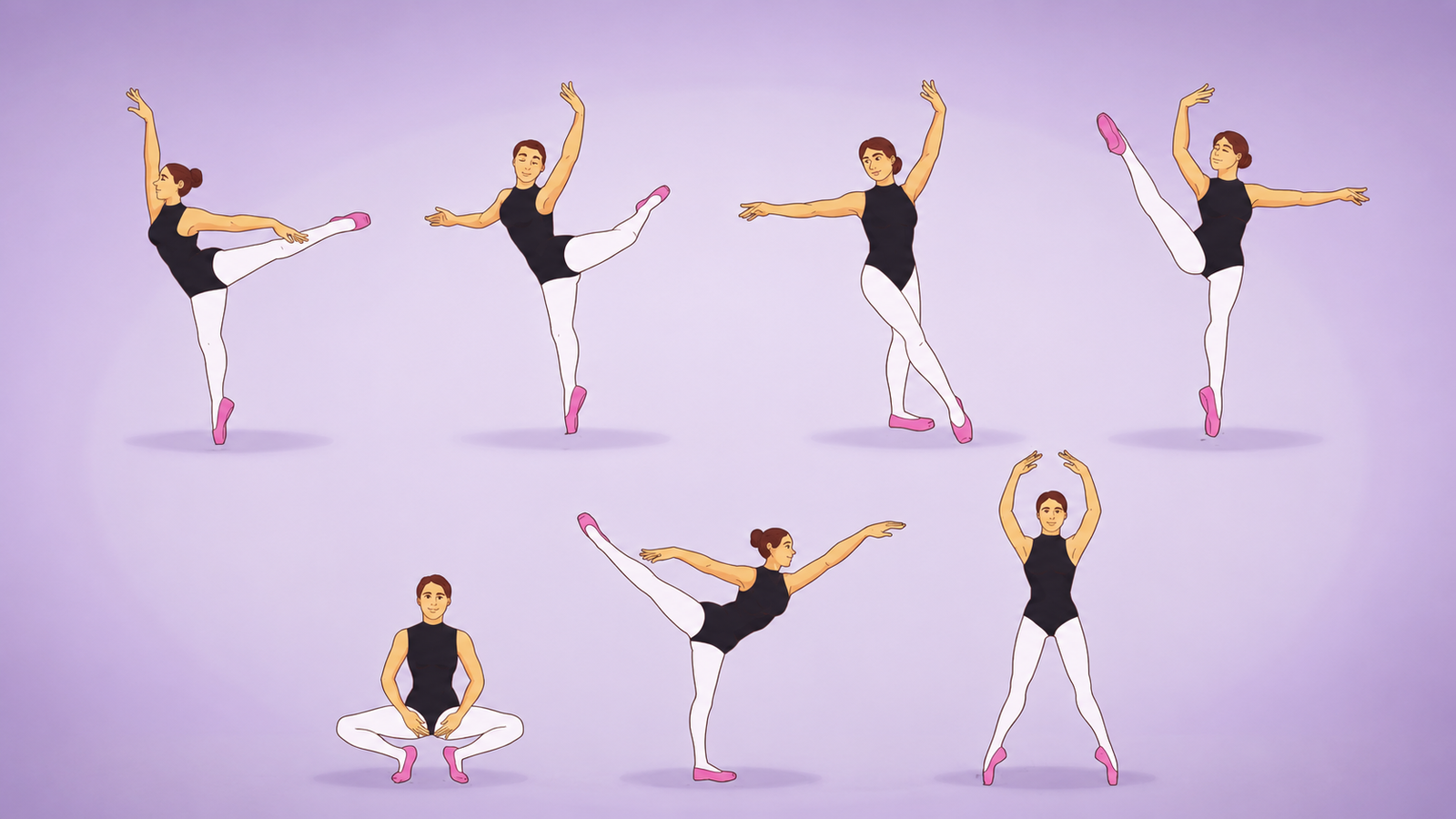
Once the five basic positions feel comfortable, dancers start learning directional poses that build on them. These include croisé, where the body is angled so one leg appears crossed in front of the other from the audience’s view, and effacé, where the body opens up so both legs are visible.
Another well known advancing position is the arabesque, where the dancer balances on one leg while extending the other straight behind the body. There are several versions of arabesque depending on arm placement and the angle of the working leg, and it is often one of the most photographed poses in classical ballet.
These advanced positions build directly on the foundation of the five basic positions, which is exactly why getting the fundamentals right early on matters so much.
Common Mistakes Beginners Make
A few mistakes show up again and again in beginner ballet classes, and being aware of them can save a lot of frustration.
- Forcing turnout from the knees or ankles instead of the hips, which strains the joints over time.
- Letting the feet roll inward, sometimes called rolling or pronating, especially in first and second position.
- Gripping the shoulders up toward the ears while trying to hold arm positions, which creates tension instead of the intended soft, rounded shape.
- Rushing straight to fifth position before the hips and ankles have the flexibility to support it safely.
- Focusing only on the feet and forgetting that the arms, head, and upper body all contribute to a correct position.
Slowing down and checking alignment in a mirror, or asking a teacher for feedback, will fix most of these issues faster than practising the same mistake repeatedly at speed.
Tips for Adult Beginners
Adults starting ballet for the first time often worry that they are too old, too stiff, or too far behind children who started young. None of that is true, and adult beginner classes exist specifically because so many people start later in life.
The main difference for adult learners is that flexibility and turnout usually take longer to develop, since bone and joint structure is already fully formed. Patience matters more than speed here. It is completely normal for an adult to spend several months simply getting comfortable with first and second position before attempting fourth or fifth with full confidence.
Wearing proper ballet flats or soft shoes, working on a non slip floor, and warming up the hips and ankles before class will all make learning the five positions more comfortable and reduce the risk of strain.
Conclusion
The five basic ballet positions are far more than a beginner exercise. They are the shared language every ballet dancer learns, from first classes as a child to professional performances on stage. Understanding first through fifth position of the feet, along with their matching arm positions, gives you a real foundation for everything else in ballet technique.
Take your time with turnout, focus on alignment over how wide a position looks, and remember that even professional dancers spent years refining these same five positions. Whether you are a parent trying to understand your child’s classes, an adult beginner starting fresh, or simply curious about ballet, mastering these basics will make every future step in your ballet journey easier to understand and enjoy.
Frequently Asked Questions
What are the five basic ballet positions?
The five basic ballet positions are first, second, third, fourth, and fifth position of the feet, each involving a different placement and degree of turnout, along with matching arm positions.
Why is third position rarely used today?
Many modern dancers have such strong turnout that third position looks almost identical to fifth position, so most contemporary training focuses more heavily on first, second, fourth, and fifth.
Is it normal for turnout to feel difficult at first?
Yes. Turnout comes from rotation at the hip joint, and building that rotation safely takes consistent practice and hip strengthening rather than forcing the feet or knees outward.
Can adults learn ballet positions as well as children?
Absolutely. Adults can learn all five positions successfully, though flexibility and turnout typically develop more slowly than in children whose joints are still growing.
Do all ballet schools teach the positions the same way?
The core five positions are shared across methods, but schools such as Vaganova, RAD, Cecchetti, and the French tradition each bring slightly different emphasis to arm shaping, terminology, and style.
